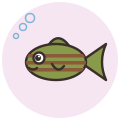
At a glance the quick version
Looks how to spot one
Scaleless catfish with feather-like dorsal fin
A sturdy catfish whose adults grow a tall dorsal fin with very long front rays that trail like a feather. It has a bony head plate, strong fin spines and whisker-like barbels around a downward-facing mouth.324
Personality what they are like
A calm, mainly evening-active catfish that keeps to the bottom and sometimes flips onto its back to swim under roots and overhangs.31
Daily activity how busy a day looks
Moderately active forager that rests in shelter by day and explores the bottom more in the evening.31
Grooming and care the hands-on bits
Avoid housing it with fin-nipping fish, since the long dorsal rays tempt them. Provide caves or roots for cover and handle with care because of the stiff fin spines.34
Home where they are happiest
Tropical water of about 22 to 26 C, pH 6.2 to 7.5 and hardness up to 15 dH, over a soft or muddy bottom with rocks and hiding places.1
Food basics what goes in the bowl
In the wild it eats mostly insect larvae plus some algae; in the aquarium offer sinking pellets and tablets, frozen foods and some plant matter.14
Company who they like around
Gets along with most peaceful community fish of similar size; keep away from fin-nippers.3
The story where it all began
George Albert Boulenger described the species in 1901 from Lake No on the White Nile. Its name comes from Greek for 'beautiful fin', and it began appearing in aquarium literature around 1990.31
Fun facts for the dinner table
- 1
Its common name combines two talents: the squeaks it makes to talk to other squeakers and its feather-like dorsal fin.2
- 2
Like its relatives it makes its squeaks by rubbing the base of its pectoral fin spines.4
- 3
It sometimes swims upside down, especially when gliding under roots.3
- 4
Young fish look very different from adults, with a crisp white bar on the tail stalk that fades as they grow.3
Recognised by the official bits
- IUCN Red List
- Least Concern (assessed 2 September 2019)1
- Taxonomy
- Described by Boulenger in 1901; type locality Lake No on the White Nile3
- Family
- Mochokidae (squeakers or upside-down catfishes)1
The care rhythm Furry Diary remembers it for you
A typical home-care rhythm for a Featherfin Squeaker. It is our own starting plan, not a vet's advice, and you can change every line in the app.
- Feedingevery day
- Water changeAbout 30 to 50% of the waterevery week
- Water testevery week
- Filter rinseevery 2 weeks
You might also like
 Polka-dot Synodontis
 Cuckoo Catfish
 Upside-down Catfish
Like what we are building? Buy us a coffee.
The breed atlas is free for everyone, with a source on every fact, and it will never show ads. If it helped you, a small tip keeps the research going. Any amount is lovely, and no is a perfectly fine answer too.
Where this comes from
Every breed page shows where each fact comes from. If we got something wrong, sorry, we are pet people, not a science magazine. Tell us at support@furrydiary.app and we will fix it.
- FishBase: Synodontis eupterus fishbase.seused for distribution, size, water parameters, diet, IUCN, upside-down habit
- Wikipedia: Synodontis eupterus en.wikipedia.orgused for names, size, name meaning
- Wikipedia (German): Synodontis eupterus de.wikipedia.orgused for appearance, juvenile vs adult colour, behaviour, history
- Wikipedia: Synodontis en.wikipedia.orgused for genus traits, sound production, diet
Checked 2026-09-30. Text is written in our own words from these sources.