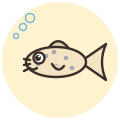
Not furry, but we like them anyway.
Cuckoo Catfish
Synodontis multipunctatus Boulenger, 1898
Also called Cuckoo squeaker, Multipunk, Cuckoo synodontis
From Endemic to Lake Tanganyika and tributaries of the Malagarasi in East Africa, living over mud and rocks down to about 100 m.123
At a glance the quick version
Looks how to spot one
Scaleless squeaker catfish
A neat, spotted catfish with a pale body covered in large dark spots, a bony head, strong fin spines and long barbels. In aquariums it usually stays nearer 15 cm than its wild maximum.32
Personality what they are like
A lively catfish that tends to become more territorial with age, especially toward other Synodontis, while living calmly alongside cichlids.23
Daily activity how busy a day looks
Busy and visible for a catfish, often foraging in daylight as well as at night.2
Grooming and care the hands-on bits
Suits a Lake Tanganyika or Malawi cichlid tank. Give fine sand for digging and plenty of caves, stones or clay pots.32
Home where they are happiest
Hard, alkaline water of about 21 to 26 C, pH 7.2 to 8.2 and hardness 10 to 20 dGH; around 450 litres for a group of 5 to 8.13
Food basics what goes in the bowl
A bottom forager that takes snails and other small creatures in the wild; in captivity it accepts frozen foods, mosquito larvae and sinking pellets.13
Company who they like around
Best kept in a group of more than three to spread out competition, with mouthbrooding cichlids as companions.23
The story where it all began
Boulenger described the species from Lake Tanganyika in 1898. It became famous in the aquarium hobby once keepers learned that it breeds alongside mouthbrooding cichlids.12
Fun facts for the dinner table
- 1
It is the only fish known to be a brood parasite: it slips its eggs among spawning mouthbrooding cichlids so the cichlid mother carries them.2
- 2
Its eggs look so much like the host's that the cichlid picks them up into her mouth along with her own.3
- 3
The young catfish hatch first and spend about two weeks inside the host's mouth before swimming free.3
- 4
In Lake Tanganyika it gathers in large schools at around 40 m depth.2
Recognised by the official bits
- IUCN Red List
- Least Concern (assessed 28 February 2025)1
- Taxonomy
- Described by Boulenger in 18981
- Family
- Mochokidae (squeakers or upside-down catfishes)1
The care rhythm Furry Diary remembers it for you
A typical home-care rhythm for a Cuckoo Catfish. It is our own starting plan, not a vet's advice, and you can change every line in the app.
- FeedingSmall amounts once or twice a dayevery day
- Temperature checkevery day
- Water changeAbout 25% of the waterevery week
- Water testevery week
- Glass cleanevery week
- Filter rinseRinse in old tank water, never tap waterevery month
You might also like
 Featherfin Squeaker
 Polka-dot Synodontis
Like what we are building? Buy us a coffee.
The breed atlas is free for everyone, with a source on every fact, and it will never show ads. If it helped you, a small tip keeps the research going. Any amount is lovely, and no is a perfectly fine answer too.
Where this comes from
Every breed page shows where each fact comes from. If we got something wrong, sorry, we are pet people, not a science magazine. Tell us at support@furrydiary.app and we will fix it.
- FishBase: Synodontis multipunctatus fishbase.seused for distribution, size, temperature, hardness, diet, IUCN
- Wikipedia: Synodontis multipunctatus en.wikipedia.orgused for names, brood parasitism, behaviour, group keeping
- Wikipedia (German): Synodontis multipunctatus de.wikipedia.orgused for appearance, aquarium parameters, diet, breeding details
Checked 2026-09-30. Text is written in our own words from these sources.