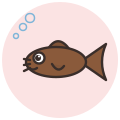
Not furry, but we like them anyway.
Upside-down Catfish
Synodontis nigriventris David, 1936
Also called Blotched upside-down catfish
From Central Africa: the middle Congo River basin (Pool Malebo, Kasai and Ubangi drainages) in Cameroon, DR Congo and Republic of the Congo, also reported from the Kouilou-Niari basin.12
At a glance the quick version
FishBase gives 9.6 cm total length; Seriously Fish gives 10 cm standard length.
Looks how to spot one
Smooth-skinned (scaleless) catfish
A small catfish with large eyes, a tall dorsal fin and three pairs of barbels. Unusually, its belly is darker than its back, so it blends in while swimming upside down. Its lighter body is marked with darker blotches, as its common name suggests.231
Personality what they are like
Gentle and peaceful, well suited to a calm community tank.32
Daily activity how busy a day looks
Mostly active at dusk and night, spending up to 90% of its time belly-up, often under leaves, wood or the water surface.321
Grooming and care the hands-on bits
Seriously Fish lists 24-28 C, pH 6.0-7.5 and 5-20 dGH; FishBase gives 22-26 C, pH 6.0-8.0 and 5-12 dH. Provide wood, broad-leaved plants and caves to hang under, and dim areas for daytime resting.31
Home where they are happiest
Minimum about 75 x 30 x 30 cm (70 litres) for a group, larger is better.31
Food basics what goes in the bowl
Omnivorous: in the wild it eats insects, crustaceans and plant matter at night. In aquariums it takes frozen, live and dried foods plus peas and cucumber, and will feed upside down at the surface.13
Company who they like around
Should be kept in a group; Seriously Fish suggests at least 3-4, FishBase five or more. Good companions include African tetras, dwarf cichlids and small mormyrids.31
The story where it all began
Described scientifically in 1936, it has become one of the most widely available Synodontis in the aquarium trade, loved for its upside-down lifestyle.13
Fun facts for the dinner table
- 1
Its colours are reversed compared with most fish, a dark belly and lighter back, which camouflages it while swimming inverted.2
- 2
Young fish start swimming upside down at about two months old.2
- 3
Adults actually swim faster upside down than the right way up.2
- 4
It spends up to 90% of its time swimming belly-up.3
Recognised by the official bits
- IUCN Red List
- Least Concern (assessed 16 February 2009)1
- Taxonomy
- Family Mochokidae; described by David in 19361
The care rhythm Furry Diary remembers it for you
A typical home-care rhythm for a Upside-down Catfish. It is our own starting plan, not a vet's advice, and you can change every line in the app.
- FeedingSmall amounts once or twice a dayevery day
- Temperature checkevery day
- Water changeAbout 25% of the waterevery week
- Water testevery week
- Glass cleanevery week
- Filter rinseRinse in old tank water, never tap waterevery month
You might also like
 Synodontis Petricola
 Pictus Catfish
 Featherfin Squeaker
Like what we are building? Buy us a coffee.
The breed atlas is free for everyone, with a source on every fact, and it will never show ads. If it helped you, a small tip keeps the research going. Any amount is lovely, and no is a perfectly fine answer too.
Where this comes from
Every breed page shows where each fact comes from. If we got something wrong, sorry, we are pet people, not a science magazine. Tell us at support@furrydiary.app and we will fix it.
- FishBase: Synodontis nigriventris summary fishbase.seused for distribution, length, water parameters, IUCN, diet, group size
- Wikipedia: Synodontis nigriventris en.wikipedia.orgused for description, behaviour, camouflage, distribution
- Seriously Fish: Synodontis nigriventris seriouslyfish.comused for size, tank size, water parameters, diet, temperament, behaviour
Checked 2026-09-30. Text is written in our own words from these sources.