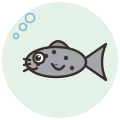
Not furry, but we like them anyway.
Polka-dot Synodontis
Synodontis angelicus Schilthuis, 1891
Also called Angel squeaker, Polkadot squeaker, Angel cat, Black clown catfish, Whitespotted squeaker
From Congo River basin in the Democratic Republic of the Congo and Republic of the Congo, including Pool Malebo and the Kasai and Ubangi drainages.12
At a glance the quick version
Looks how to spot one
Scaleless squeaker catfish
A deep-bodied catfish with a forked tail, stiff serrated spines on the dorsal and pectoral fins, and a dark body dotted with light spots. Young fish are especially bright, with round white spots on a red-violet base.23
Personality what they are like
Very nocturnal and seldom seen by day. Adults can become territorial toward other bottom-dwellers, especially other Synodontis.32
Daily activity how busy a day looks
Rests in shelter by day and digs and forages over the bottom at night.23
Grooming and care the hands-on bits
Give caves and roots for daytime hiding; it may dig and nibble soft plants. Choose companions too big to be eaten.23
Home where they are happiest
Tropical water of 24 to 28 C, pH 6.0 to 8.0 and hardness about 3 to 20 dGH, in a tank with a base of at least 120 x 45 cm.132
Food basics what goes in the bowl
Omnivorous and easy to feed: frozen, live and dried foods, plus vegetables such as peas or cucumber that it rasps with its lower teeth.32
Company who they like around
Does well with tetras, cichlids, knifefish and gouramis; often best as the only Synodontis.3
The story where it all began
Louise Schilthuis described it in 1891 from Pool Malebo on the Congo River. Its striking spots made it a sought-after and once very costly aquarium catfish.23
Fun facts for the dinner table
- 1
Its scientific name angelicus means 'heavenly', a nod to the vivid colours of the young fish.2
- 2
Spot colour and base colour vary a lot depending on where a fish comes from.3
- 3
Its lower jaw carries movable S-shaped teeth, while the upper jaw has cone-shaped ones.2
- 4
With good care it can live for more than 20 years.3
Recognised by the official bits
- IUCN Red List
- Least Concern (assessed 16 February 2009)1
- Taxonomy
- Described by Louise Schilthuis in 1891 from Pool Malebo2
- Family
- Mochokidae (squeakers or upside-down catfishes)1
The care rhythm Furry Diary remembers it for you
A typical home-care rhythm for a Polka-dot Synodontis. It is our own starting plan, not a vet's advice, and you can change every line in the app.
- Feedingevery day
- Water changeAbout 30 to 50% of the waterevery week
- Water testevery week
- Filter rinseevery 2 weeks
You might also like
 Featherfin Squeaker
 Cuckoo Catfish
Like what we are building? Buy us a coffee.
The breed atlas is free for everyone, with a source on every fact, and it will never show ads. If it helped you, a small tip keeps the research going. Any amount is lovely, and no is a perfectly fine answer too.
Where this comes from
Every breed page shows where each fact comes from. If we got something wrong, sorry, we are pet people, not a science magazine. Tell us at support@furrydiary.app and we will fix it.
- FishBase: Synodontis angelicus fishbase.seused for distribution, max size, water parameters, IUCN
- Wikipedia: Synodontis angelicus en.wikipedia.orgused for names, etymology, appearance, behaviour, history
- Seriously Fish: Synodontis angelicus seriouslyfish.comused for tank size, water parameters, diet, behaviour, colour variation, lifespan
Checked 2026-09-30. Text is written in our own words from these sources.