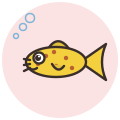
Not furry, but we like them anyway.
Synodontis Petricola
Synodontis petricola Matthes, 1959
Also called Pygmy leopard catfish, Dwarf lake synodontis, False cuckoo synodontis, Cuckoo catfish (FishBase usage)
From Endemic to Lake Tanganyika, East Africa (Burundi, DR Congo, Tanzania and Zambia).12
At a glance the quick version
FishBase gives 10.2 cm TL; Wikipedia 11.5 cm SL / 13.5 cm TL; Seriously Fish 13 cm SL.
Looks how to spot one
Smooth-skinned (scaleless) catfish
A stocky little catfish with a strong bony head and three pairs of white barbels. The yellowish to copper-brown body is covered with bold black spots, and the fins have dark triangular bases with crisp white edges. Black bars cross each lobe of the tail.2
Personality what they are like
One of the most peaceful Synodontis available; sociable with its own kind and calm with tankmates too big to swallow.3
Daily activity how busy a day looks
Busy and inquisitive, especially in a group, foraging over rocks and the substrate.32
Grooming and care the hands-on bits
A hard, alkaline water fish: Seriously Fish lists 24-28 C, pH 7.5-8.5 and 10-35 dGH, while FishBase gives 22-25 C and pH 8.0-9.0. Rockwork with caves suits it, and it adapts to a range of water chemistry.31
Home where they are happiest
Lives along rocky shorelines in Lake Tanganyika down to about 30 m. Minimum around 90 x 30 cm base (about 81 litres) for a group.23
Food basics what goes in the bowl
An adaptable omnivore: in the wild adults eat sponges, algae, plant detritus and small crustaceans. In aquariums it takes frozen, live and dried foods plus vegetables such as cucumber and peas.23
Company who they like around
Keep in a group of four or more alongside hard-water cichlids, rainbowfish or livebearers.3
The story where it all began
Belgian ichthyologist Hubert Matthes described the species in 1959 from Lake Tanganyika. It has since become a favourite with keepers of Tanganyikan cichlid tanks.23
Fun facts for the dinner table
- 1
Its name petricola means 'rock dweller', from the Latin petra (rock) and cola (inhabitant).2
- 2
Spawning pairs swim side by side in unison.2
- 3
It has a small pore under its shoulder plate whose purpose is still unknown.2
- 4
Young fish are meat-eaters, feeding on water mites, seed shrimps and insect larvae.2
Recognised by the official bits
- IUCN Red List
- Least Concern (assessed 26 February 2025)1
- Taxonomy
- Family Mochokidae; described by Hubert Matthes in 19592
The care rhythm Furry Diary remembers it for you
A typical home-care rhythm for a Synodontis Petricola. It is our own starting plan, not a vet's advice, and you can change every line in the app.
- FeedingSmall amounts once or twice a dayevery day
- Temperature checkevery day
- Water changeAbout 25% of the waterevery week
- Water testevery week
- Glass cleanevery week
- Filter rinseRinse in old tank water, never tap waterevery month
You might also like
 Upside-down Catfish
 Cuckoo Catfish
 Pictus Catfish
Like what we are building? Buy us a coffee.
The breed atlas is free for everyone, with a source on every fact, and it will never show ads. If it helped you, a small tip keeps the research going. Any amount is lovely, and no is a perfectly fine answer too.
Where this comes from
Every breed page shows where each fact comes from. If we got something wrong, sorry, we are pet people, not a science magazine. Tell us at support@furrydiary.app and we will fix it.
- FishBase: Synodontis petricola summary fishbase.seused for distribution, length, water parameters, IUCN
- Wikipedia: Synodontis petricola en.wikipedia.orgused for names, description, size, habitat, diet, history, etymology
- Seriously Fish: Synodontis petricola seriouslyfish.comused for names, size, tank size, water parameters, diet, temperament, companions
Checked 2026-09-30. Text is written in our own words from these sources.