Not furry, but we like them anyway.
Rosy Red Minnow
Pimephales promelas
Also called Rosy red, Rosy-red fathead minnow, Fathead minnow (wild form), Tuffy
From Wild fathead minnow is native to North America, from Canada south to the Gulf states and Mexico; the rosy-red colour strain appeared on Arkansas fish farms12
At a glance the quick version
Males weigh about 3 to 5 g, females about 2 to 3 g (wild fathead minnow)
Looks how to spot one
Small, deep-bodied scaled fish
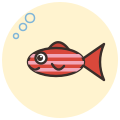
A small, stocky minnow with a rounded head. In breeding season males grow a spongy grey pad on the back of the head and small white bumps on the snout, which they use while tending eggs. The rosy-red form swaps the wild olive colour for a pinkish-gold body and fins.23
Personality what they are like
Peaceful and sociable, preferring to swim with familiar fish. Breeding males become territorial around their nest site.3
Daily activity how busy a day looks
An active, schooling fish that also spends time picking food from the bottom.32
Grooming and care the hands-on bits
Easy to keep in garden ponds or coldwater tanks. Give flat stones, pots or similar objects with an overhang so males can set up nests underneath.32
Home where they are happiest
Very adaptable. Copes with water from about 0 to 33 °C and with cloudy, warm or low-oxygen conditions that many fish avoid.13
Food basics what goes in the bowl
Omnivore and bottom filter feeder. Eats algae, detritus, small crustaceans, zooplankton and insect larvae; accepts small prepared foods.321
Company who they like around
Lives in schools and recognises familiar companions by scent, so keep it in a group.3
The story where it all began
The fathead minnow is a widespread North American fish long used as bait and as a feeder fish. The rosy-red colour strain was found on several Arkansas breeding farms in 1985 and is now a popular pond and aquarium fish.23
Fun facts for the dinner table
- 1
The male guards the eggs alone, fanning them and cleaning them with the spongy pad on his head until they hatch.3
- 2
Nests are made on the underside of flat objects such as stones, logs or pots.3
- 3
A single female can spawn 16 to 26 times in a season.2
- 4
Fathead minnows are North America's most widely used model fish in environmental toxicology research.3
- 5
Like many minnows, they release an alarm scent when injured to warn their school.2
Recognised by the official bits
- IUCN Red List
- Wild species Pimephales promelas assessed as Least Concern (2018)1
- US Environmental Protection Agency
- The fathead minnow is a standard indicator species in EPA vertebrate toxicity testing2
The care rhythm Furry Diary remembers it for you
A typical home-care rhythm for a Rosy Red Minnow. It is our own starting plan, not a vet's advice, and you can change every line in the app.
- Feedingevery day
- Water changeAbout 25 to 30% of the waterevery week
- Water testevery week
- Glass cleanevery week
- Filter rinseevery month
You might also like
 Eurasian Minnow
 White Cloud Mountain Minnow
 Comet Goldfish
 Zebra Danio
Like what we are building? Buy us a coffee.
The breed atlas is free for everyone, with a source on every fact, and it will never show ads. If it helped you, a small tip keeps the research going. Any amount is lovely, and no is a perfectly fine answer too.
Where this comes from
Every breed page shows where each fact comes from. If we got something wrong, sorry, we are pet people, not a science magazine. Tell us at support@furrydiary.app and we will fix it.
- FishBase: Pimephales promelas fishbase.seused for range, size, age, temperature, diet, IUCN status
- Wikipedia: Fathead minnow en.wikipedia.orgused for rosy-red strain history, appearance, size, lifespan, breeding, uses, fun facts
- Animal Diversity Web: Pimephales promelas animaldiversity.orgused for appearance, weight, lifespan, habitat, behaviour, breeding, diet
Checked 2026-09-30. Text is written in our own words from these sources.