At a glance the quick version
Looks how to spot one
Small, slender scaled minnow
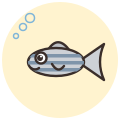
A torpedo-shaped little fish with a flattened side profile and bold horizontal blue stripes running from gill to tail fin. Males tend to show golden tones between the stripes and have larger anal fins, while females show silver between the stripes and have a fuller, paler belly. It carries two pairs of small barbels near the mouth.14
Personality what they are like
An energetic, sociable fish that is always on the move, darting around in a tight group. It is peaceful with other fish, while within its own shoal it sorts out a friendly pecking order through short chases. It is active in the daytime and is one of the easiest fish to watch in a community tank.341
Daily activity how busy a day looks
Very active and fast; it needs a long tank with plenty of open swimming room and some water movement to enjoy.3
Grooming and care the hands-on bits
Hardy and forgiving. Keep a group of at least 8-10, feed small meals once or twice a day and change part of the water regularly. A tight-fitting lid is sensible because danios are quick swimmers near the surface.36
Home where they are happiest
Aquarium with a base of at least 90 x 30 cm for a small group (FishBase gives 60 cm as a minimum length). Water temperature about 18-25 C, pH 6.0-8.0, hardness about 5-20 dGH. Plants around the edges with open water in the middle suit it well. In the wild it lives in shallow, slow or still water such as rice paddies, ditches and stream edges with silty or sandy bottoms.321
Food basics what goes in the bowl
Omnivorous. Wild fish eat zooplankton, small crustaceans, worms, insect larvae (including mosquito larvae) and insects that fall on the water. In the aquarium it takes good-quality flakes or granules readily, ideally with small live or frozen foods like daphnia, brine shrimp and bloodworm added.342
Company who they like around
A true shoaling fish that should live in a group, ideally 8-10 or more; in groups it shows its best colour and most natural behaviour. Mixes well with other small peaceful fish such as tetras, rasboras, livebearers, loaches and small catfish.32
The story where it all began
The Scottish naturalist Francis Hamilton described the fish in 1822 from the Kosi River in the Ganges basin, originally placing it in the carp genus Cyprinus, and for a long time it was known as Brachydanio rerio before being moved to Danio. It became one of the classic beginner aquarium fish because it is hardy and breeds easily. From the 1970s, George Streisinger at the University of Oregon turned it into a laboratory model animal, and in the early 1980s his group became the first to clone a vertebrate using zebrafish. Today thousands of scientists around the world study it, helped by its see-through embryos that develop outside the mother. In 1999 scientists at the National University of Singapore created fluorescent zebrafish, and from late 2003 these were sold to aquarium keepers under the GloFish brand, later in a whole range of glowing colours.1754
Fun facts for the dinner table
- 1
Zebrafish were the first vertebrate ever cloned, in George Streisinger's lab at the University of Oregon.7
- 2
It is one of the few fish species that has been sent into space.1
- 3
Zebrafish can regrow parts of their heart, retina and spinal cord.1
- 4
Its genome has been fully sequenced, and about 70% of human genes have a counterpart in the zebrafish.1
- 5
It has four kinds of colour-sensing cone cells in its eyes, including ones that detect ultraviolet light.1
- 6
GloFish fluorescent zebrafish were first developed in Singapore in 1999 with the aim of detecting water pollution.5
- 7
A single spawning can produce anywhere from 1 to about 700 eggs, around 185 on average.4
Recognised by the official bits
- IUCN Red List
- Assessed as Least Concern (9 October 2009)2
- FishBase
- Listed as highly commercial in the aquarium trade and as a research model organism2
- Taxonomy (Hamilton, 1822)
- First described by Francis Hamilton in 1822 from the Kosi River in the lower Ganges basin1
The care rhythm Furry Diary remembers it for you
A typical home-care rhythm for a Zebra Danio. It is our own starting plan, not a vet's advice, and you can change every line in the app.
- FeedingSmall amounts once or twice a dayevery day
- Temperature checkevery day
- Water changeAbout 25% of the waterevery week
- Water testevery week
- Glass cleanevery week
- Filter rinseRinse in old tank water, never tap waterevery month
You might also like
 White Cloud Mountain Minnow
 Neon Tetra
 Guppy
GuppyLike what we are building? Buy us a coffee.
The breed atlas is free for everyone, with a source on every fact, and it will never show ads. If it helped you, a small tip keeps the research going. Any amount is lovely, and no is a perfectly fine answer too.
Where this comes from
Every breed page shows where each fact comes from. If we got something wrong, sorry, we are pet people, not a science magazine. Tell us at support@furrydiary.app and we will fix it.
- Zebrafish - Wikipedia en.wikipedia.orgused for names, range, size, lifespan, colours, history, fun facts
- Danio rerio - FishBase fishbase.seused for length, lifespan, water parameters, distribution, IUCN status
- Brachydanio rerio - Seriously Fish seriouslyfish.comused for tank size, water parameters, temperament, diet, group size, strains
- Danio rerio - Animal Diversity Web (University of Michigan) animaldiversity.orgused for body description, lifespan, behaviour, diet, reproduction
- GloFish - Wikipedia en.wikipedia.orgused for fluorescent strains history and colours
- The Zebrafish Book, ch.1 - ZFIN zfin.orgused for feeding frequency and water change practice
- George Streisinger - Wikipedia en.wikipedia.orgused for research history and first vertebrate clone
Checked 2026-09-30. Text is written in our own words from these sources.