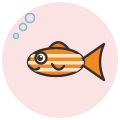
At a glance the quick version
FishBase gives 3.5 cm SL, Seriously Fish about 4.5 cm SL and Wikipedia up to 6 cm
Looks how to spot one
Slender, elongated scaled cyprinid
A small, streamlined danio with two pairs of long barbels. Some fish carry neat horizontal stripes along the flanks while others show a wavy or spotted pattern, and the fins glow orange to red. Females are a little larger and rounder than males.123
Personality what they are like
Calm and friendly towards other fish, it suits a well-planted community tank. It shows its best behaviour and colour when kept in a decent-sized group.1
Daily activity how busy a day looks
A lively schooling fish that uses the whole tank and appreciates open swimming room plus gentle water movement.1
Grooming and care the hands-on bits
Keep the water clean and well oxygenated with regular partial changes. It is a skilled jumper, so a tight-fitting lid is a must.1
Home where they are happiest
A tank with a base of at least 90 x 30 cm (about 81 litres). Temperature 16-26 °C, pH 6.5-7.5, soft water around 1-5 °H. Stones, gravel and plants along the edges echo its shaded home streams.1
Food basics what goes in the bowl
In the wild it mostly eats insects and their larvae. It takes most aquarium foods; small live or frozen foods such as bloodworm and Artemia alongside good dried food bring out the best colour.1
Company who they like around
Keep a group of at least 8-10. Good companions are other small, peaceful fish such as tetras, livebearers, rainbowfish and small cyprinids.1
The story where it all began
Fang Fang described this danio in 1998 from streams near Myitkyina in northern Myanmar. It is a close relative of the zebra danio, and the striped orange-finned form has since been studied as a separate lineage from the spotted ocelot form.231
Fun facts for the dinner table
- 1
Its species name kyathit is the Burmese word for leopard, a nod to its spotted pattern.1
- 2
It is a close cousin of the famous zebra danio, the zebrafish used in science labs.3
- 3
It has two pairs of long barbels, longer than those of the zebra danio.2
- 4
Its wild streams run under bamboo forest that shades more than 80 percent of the water.2
Recognised by the official bits
- IUCN Red List
- Assessed as Near Threatened (January 2010)2
- FishBase
- Described by Fang in 19982
The care rhythm Furry Diary remembers it for you
A typical home-care rhythm for a Orange-finned Danio. It is our own starting plan, not a vet's advice, and you can change every line in the app.
- FeedingSmall amounts once or twice a dayevery day
- Temperature checkevery day
- Water changeAbout 25% of the waterevery week
- Water testevery week
- Glass cleanevery week
- Filter rinseRinse in old tank water, never tap waterevery month
You might also like
 Zebra Danio
 Pearl Danio
Like what we are building? Buy Archy a bone.
All of this is free for everyone, with a source on every fact, and it will never show ads. It was a big job to build, so if it helped you, buy Archy a bone. Any amount is lovely, and no is a perfectly fine answer too.
Archy is our Australian Cattle Dog and chief taste tester. Tips go to 4V3D OÜ, the small family studio behind Furry Diary.
Where this comes from
Every breed page shows where each fact comes from. If we got something wrong, sorry, we are pet people, not a science magazine. Tell us at support@furrydiary.app and we will fix it.
- Seriously Fish - Danio kyathit seriouslyfish.comused for origin, size, tank and water parameters, diet, behaviour, appearance, name meaning
- FishBase - Danio kyathit fishbase.seused for author/year, IUCN status, size, habitat, barbels
- Wikipedia - Orange-finned Danio en.wikipedia.orgused for other names, size, relation to zebra danio, colour forms
Checked 2026-09-30. Text is written in our own words from these sources.