At a glance the quick version
Looks how to spot one
Long-bodied combtooth blenny with a lyre-shaped tail
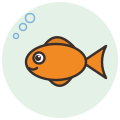
A long blenny that swims with a wavy, eel-like motion. Most are deep golden orange with a blue shadow under the chin and blue-ringed eyes, though some are grey, greenish or yellow. It has a small black spot near the vent.123
Personality what they are like
Generally peaceful and a good reef fish, though it can bully small plankton-eaters, firefish and gobies, especially in smaller tanks.3
Daily activity how busy a day looks
Spends time both perching on rock and swimming in open water a few metres above the bottom.13
Grooming and care the hands-on bits
A larger tank with lots of rocks for perching helps keep it calm and reduces squabbles.3
Home where they are happiest
Minimum about 30 US gallons (114 L), reef safe. Saltwater at about 22 to 26 °C, pH 8.1 to 8.4, dKH 8 to 12, specific gravity 1.020 to 1.025. Wild fish live along clear coastal and outer reef walls with moderate current, at 2 to 40 m.31
Food basics what goes in the bowl
Plankton eater in the wild. In the aquarium it takes meaty foods such as chopped crustaceans, mysis and enriched brine shrimp, plus some frozen herbivore food.123
Company who they like around
In the wild it often joins schools of similar-coloured fish such as the lyretail anthias. Keep one per tank.12
The story where it all began
Walter Starck described the species in 1969. Its name refers to King Midas of Greek myth, whose touch turned things to gold, because of the fish's golden colour.12
Fun facts for the dinner table
- 1
Its name honours King Midas, whose touch turned things to gold.1
- 2
It mixes into schools of lyretail anthias and copies their colour and swimming style.1
- 3
It can switch colour quickly as it moves between the reef bottom and open water.1
- 4
Unlike most blennies, it feeds on plankton up in the water column.2
Recognised by the official bits
- IUCN Red List
- Least Concern (assessed 2009)1
The care rhythm Furry Diary remembers it for you
A typical home-care rhythm for a Midas Blenny. It is our own starting plan, not a vet's advice, and you can change every line in the app.
- FeedingSmall amounts once or twice a dayevery day
- Temperature checkevery day
- Salinity checkevery week
- Top-upTop up evaporation with fresh RO water, not salt waterevery day
- Water testevery week
- Water changeAbout 10 to 20% of the waterevery 2 weeks
- Glass cleanevery week
You might also like
 Bicolor Blenny
 Tailspot Blenny
 Lawnmower Blenny
Like what we are building? Buy us a coffee.
The breed atlas is free for everyone, with a source on every fact, and it will never show ads. If it helped you, a small tip keeps the research going. Any amount is lovely, and no is a perfectly fine answer too.
Where this comes from
Every breed page shows where each fact comes from. If we got something wrong, sorry, we are pet people, not a science magazine. Tell us at support@furrydiary.app and we will fix it.
- FishBase: Ecsenius midas fishbase.seused for distribution, size, depth, habitat, mimicry, diet, IUCN, etymology, describer
- Wikipedia: Ecsenius midas en.wikipedia.orgused for other names, colour change, diet, name origin
- LiveAquaria: Midas Blenny liveaquaria.comused for care, tank size, water parameters, diet, temperament
Checked 2026-09-30. Text is written in our own words from these sources.