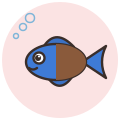
Not furry, but we like them anyway.
Bicolor Blenny
Ecsenius bicolor
Also called Bicolor coralblenny, Bicolor combtooth blenny, Flame tail blenny, Salarias bicolor (original name)
From Indo-Pacific: Maldives to the Phoenix Islands, north to the Ryukyu Islands and south to the southern Great Barrier Reef, throughout Micronesia12
At a glance the quick version
Looks how to spot one
Slender combtooth blenny
A small, slim blenny best known for its two-tone look: dark blue to brown at the front and orange at the back. Some fish show other colour phases, with a dark back, a broad white side band and a yellow or dusky tail.13
Personality what they are like
Generally peaceful and full of character, though it may nip at other blennies, gobies or dartfish.3
Daily activity how busy a day looks
Perches on rocks and pops in and out of crevices and holes.31
Grooming and care the hands-on bits
Keep it well fed with plant-based foods and provide lots of rock with crevices and holes to claim as a home.3
Home where they are happiest
Minimum about 30 US gallons (114 L). Saltwater at about 22 to 26 °C, pH 8.1 to 8.4, dKH 8 to 12, specific gravity 1.020 to 1.025. Wild fish live on clear lagoon and seaward reefs with mixed corals and algae-covered rock, at 1 to 25 m.31
Food basics what goes in the bowl
Mainly herbivorous. Offer algae and vegetable-based foods along with what it grazes from the rocks.31
Company who they like around
Lives singly in the wild, often in an old tube or hole. Best kept as the only blenny of its kind.13
The story where it all began
Francis Day described it in 1888 as Salarias bicolor. Over time it collected several other scientific names before settling in the genus Ecsenius. It is a regular in the aquarium trade.2
Fun facts for the dinner table
Recognised by the official bits
- IUCN Red List
- Least Concern (assessed 2009)1
The care rhythm Furry Diary remembers it for you
A typical home-care rhythm for a Bicolor Blenny. It is our own starting plan, not a vet's advice, and you can change every line in the app.
- FeedingSmall amounts once or twice a dayevery day
- Temperature checkevery day
- Salinity checkevery week
- Top-upTop up evaporation with fresh RO water, not salt waterevery day
- Water testevery week
- Water changeAbout 10 to 20% of the waterevery 2 weeks
- Glass cleanevery week
You might also like
 Midas Blenny
 Tailspot Blenny
 Lawnmower Blenny
Like what we are building? Buy us a coffee.
The breed atlas is free for everyone, with a source on every fact, and it will never show ads. If it helped you, a small tip keeps the research going. Any amount is lovely, and no is a perfectly fine answer too.
Where this comes from
Every breed page shows where each fact comes from. If we got something wrong, sorry, we are pet people, not a science magazine. Tell us at support@furrydiary.app and we will fix it.
- FishBase: Ecsenius bicolor fishbase.seused for distribution, size, depth, habitat, colour phases, behaviour, IUCN
- Wikipedia: Ecsenius bicolor en.wikipedia.orgused for history, other names, size
- LiveAquaria: Bicolor Blenny liveaquaria.comused for care, tank size, water parameters, diet, temperament
Checked 2026-09-30. Text is written in our own words from these sources.