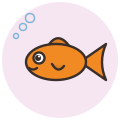
Not furry, but we like them anyway.
Golden Orfe
Leuciscus idus
Also called Golden ide, Goldorfe, Orfe, Ide (wild form), Aland
From Ornamental colour form of the ide, a freshwater fish native to Europe and western Asia (North Sea rivers and southern Scandinavia east to the Caspian basin and the Lena river in Siberia). The golden form was bred for stocking ponds in parks and gardens.123
At a glance the quick version
Looks how to spot one
Scaled, streamlined cyprinid
A slim, torpedo-shaped fish built for open-water swimming. The ornamental form shines in tones from pale white-gold to deep orange, often with a few dark speckles on the upper head and neck. The wild ide is silvery, and a rarer blue-backed form also exists.13
Personality what they are like
Peaceful and sociable. Young orfe happily join mixed shoals, and in a pond the group tends to cruise together just under the surface. They can start out a little shy but soon learn when food is coming and gather for it.132
Daily activity how busy a day looks
An active, fast swimmer that spends most of its time moving around the upper water layer. It needs open swimming room rather than a cramped space, and moves down to deeper water when it gets cold.312
Grooming and care the hands-on bits
Needs clean, well-oxygenated water, more so than koi or goldfish. Wild ides live in cool water of roughly 4 to 20 C, with a pH of about 7.0 to 7.5 and moderate hardness. A pond with good aeration and filtration and a deeper area for winter suits it.123
Home where they are happiest
An outdoor pond fish, not an indoor aquarium fish. FishBase notes it is unsuitable for home aquariums and would need a tank over 2 m long, so a roomy garden or park pond is the right home. Provide open water for swimming and a deeper zone where the fish can rest in winter.123
Food basics what goes in the bowl
An omnivore. In the wild it eats insect larvae and adult insects, snails and other small invertebrates plus some plant matter, and big adults also take small fish. In a pond it readily accepts floating pond-fish food and also snaps up mosquito larvae and insects at the surface.123
Company who they like around
Keep as a shoal of several fish rather than singly. It mixes well with koi and goldfish in the same pond. Young fish are especially gregarious, while very large wild adults roam in smaller groups.123
The story where it all began
The ide has a huge natural range across Europe and northern Asia, and Carl Linnaeus gave it a scientific name in 1758. People have long fished it, both for food in eastern Europe, where it is still netted along the Danube, and as a sport fish. A golden colour form was selected and bred specifically to decorate ponds in parks and gardens, where its habit of swimming near the surface makes it easy to watch. The species was brought to Great Britain in 1874 and to the United States in 1877, and the golden orfe went on to become one of the best known ornamental pond fish. It stayed the leading decorative pond fish until koi became widely available in the 1960s. Silver and blue forms are also kept today.1234
Fun facts for the dinner table
- 1
The English name 'ide' comes from the Swedish word id, which originally referred to the fish's bright colour.1
- 2
The alternative name 'orfe' traces back through German to a Latin word for a sea fish.1
- 3
Golden orfe were the favourite decorative pond fish until koi became easy to buy in the 1960s.1
- 4
Young silver ides have been seen to change colour to gold on their own, while golden fish released into the wild tend to revert towards the silver wild look over generations.3
- 5
A single female can lay up to around 100,000 eggs in a spawning season.4
- 6
Pond keepers value orfe because they eat mosquito larvae near the surface.3
- 7
The heaviest ide caught on rod and line in Europe weighed about 5.5 kg.1
- 8
Ides spawn in spring, often soon after the ice melts, and the whole spawning event usually lasts only three to four days.1
Recognised by the official bits
- IUCN Red List
- Wild species Leuciscus idus assessed as Least Concern2
- Linnaeus (Systema Naturae)
- Species first described scientifically by Carl Linnaeus in 17581
The care rhythm Furry Diary remembers it for you
A typical home-care rhythm for a Golden Orfe. It is our own starting plan, not a vet's advice, and you can change every line in the app.
- FeedingOnly in the warm seasonevery day
- Pond checkevery day
- Water testevery 2 weeks
- Filter cleanevery month
You might also like
 Koi
Koi Comet Goldfish
 Shubunkin
 Common Goldfish
 Golden Tench
 Rudd
RuddLike what we are building? Buy us a coffee.
The breed atlas is free for everyone, with a source on every fact, and it will never show ads. If it helped you, a small tip keeps the research going. Any amount is lovely, and no is a perfectly fine answer too.
Where this comes from
Every breed page shows where each fact comes from. If we got something wrong, sorry, we are pet people, not a science magazine. Tell us at support@furrydiary.app and we will fix it.
- Wikipedia: Ide (fish) en.wikipedia.orgused for range, size, weight, golden and blue forms, pond keeping, introductions, history, etymology, fun facts
- FishBase: Leuciscus idus, Ide fishbase.seused for max length and weight, max age, water temperature and pH, diet, behaviour, aquarium suitability, IUCN status
- Wikipedia (German): Goldorfe de.wikipedia.orgused for ornamental purpose, pond needs, surface feeding, behaviour, colour forms, colour change
- Wikipedia (German): Aland (Fisch) de.wikipedia.orgused for lifespan in wild and captivity, size and weight range, spawning and egg numbers, colour forms
Checked 2026-09-30. Text is written in our own words from these sources.