Pond royalty.
Koi
Cyprinus sp. (ornamental carp descended mainly from the Amur carp, Cyprinus rubrofuscus)
Also called Nishikigoi, Brocaded carp, Japanese koi, Butterfly koi (long-finned form)
From Japan: the Nijumurago area of Niigata Prefecture (around present-day Ojiya and the former village of Yamakoshi), from carp originally farmed for food12
At a glance the quick version
Looks how to spot one
Large scaled carp; also scaleless or partly scaled (Doitsu), metallic-scaled (Kinginrin) and long-finned (butterfly) forms
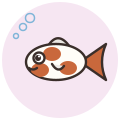
A big, sturdy, torpedo-shaped carp with a pair of barbels by the mouth. Koi are prized for the bold patterns on their backs, which are meant to be admired from above in a pond. Most have normal scales, but some lines have few or no scales, some have sparkling metallic scales, and butterfly koi have long, flowing fins.1
Personality what they are like
Peaceful and sociable pond fish. Koi soon learn who feeds them, gather at the edge at feeding time and can be trained to take food from a hand, which makes them rewarding to keep.1
Daily activity how busy a day looks
Strong swimmers that grow large, so they need a roomy, deep pond rather than an aquarium. They slow right down in cold water and eat very little in winter.12
Grooming and care the hands-on bits
Keep in a well-filtered, well-oxygenated pond with stable pH. Koi are most comfortable at about 15 to 25 C. Ponds should be at least 1 m deep in warm climates and 1.5 m or more where winters are harsh. Protect the pond from predators such as herons, kingfishers, otters, raccoons and cats, and avoid feeding when the water drops below about 10 C.1
Home where they are happiest
An outdoor garden pond with good filtration and aeration and enough depth to stay frost-free at the bottom in winter. Their wild ancestor, the Amur carp, lives in slow-flowing rivers and lakes around 2 m deep.14
Food basics what goes in the bowl
Omnivorous bottom feeders. A quality pellet diet can be topped up with treats such as peas, lettuce and watermelon. Feeding is reduced as the water cools and paused in cold water.14
Company who they like around
Sociable fish that are usually kept as a group in a shared pond, where they feed and move around together.1
The story where it all began
Carp were first kept as a food fish, and odd single-coloured carp appeared by chance in China and Japan long before anyone bred them on purpose. Deliberate breeding of coloured carp began in the 1820s in the snowy mountain villages of the Nijumurago area of Niigata, where farmers raised carp in rice-terrace ponds. Red-and-white fish came first, and colourful koi grew popular enough by 1875 that the trade was briefly banned as speculation before being allowed again. The name nishikigoi, meaning brocaded carp, came into use around 1910, and a display at the 1914 Tokyo Taisho Exposition, where koi won a silver medal, brought them national fame. The Kohaku and Taisho Sanshoku varieties were fixed by 1917 and Showa Sanshoku by 1927. During the 20th century the hobby spread worldwide, long-finned butterfly koi were developed in the 1980s, and in the 21st century collectors from across Asia have bought top fish from Niigata breeders.12
Fun facts for the dinner table
- 1
The Japanese word koi means carp, and it sounds the same as a Japanese word for love or affection.1
- 2
The three most popular varieties, known together as Gosanke, are Kohaku, Taisho Sanshoku and Showa Sanshoku.1
- 3
A famous red koi called Hanako was claimed to be 226 years old when she died in 1977, based on counting the rings on her scales, although experts consider this method unreliable.3
- 4
In 2018 a single koi sold to a collector for about 2 million US dollars.1
- 5
Japan exported about 3.6 billion yen worth of nishikigoi in 2017, nearly double the figure of a decade earlier.2
- 6
Koi and goldfish look alike when young but are separate species; goldfish were developed in China over 1,000 years ago.1
- 7
Carp-shaped koinobori streamers flown on Japan's Children's Day (5 May) are a tradition dating back to the Edo period.1
Recognised by the official bits
- Zen Nippon Airinkai (All Japan Nishikigoi Promotion Association)
- Japanese association that promotes nishikigoi, trains judges and runs the International Koi Show5
- British Koi Keepers Society
- UK national body supporting local koi clubs6
- Japan Agricultural Heritage
- Niigata's rice farming and carp-rearing system, the home of nishikigoi, was recognised as a Japan Agricultural Heritage site in 20172
The care rhythm Furry Diary remembers it for you
A typical home-care rhythm for a Koi. It is our own starting plan, not a vet's advice, and you can change every line in the app.
- FeedingOnly in the warm seasonevery day
- Pond checkevery day
- Water testevery 2 weeks
- Filter cleanevery month
You might also like
 Common Goldfish
 Fancy Goldfish
 Common Carp
 Butterfly Koi
Like what we are building? Buy us a coffee.
The breed atlas is free for everyone, with a source on every fact, and it will never show ads. If it helped you, a small tip keeps the research going. Any amount is lovely, and no is a perfectly fine answer too.
Where this comes from
Every breed page shows where each fact comes from. If we got something wrong, sorry, we are pet people, not a science magazine. Tell us at support@furrydiary.app and we will fix it.
- Wikipedia: Koi en.wikipedia.orgused for names, origin, history, varieties, colours, care, diet, behaviour, fun facts
- Japanese Wikipedia: Nishikigoi ja.wikipedia.orgused for maximum size, Niigata heritage recognition, export figures, origin area
- Wikipedia: Hanako (koi) en.wikipedia.orgused for Hanako age claim, size and weight example
- Wikipedia: Amur carp en.wikipedia.orgused for ancestral species, wild habitat, diet
- Zen Nippon Airinkai zna.jpused for recognition / show organisation
- British Koi Keepers Society bkks.co.ukused for recognition / UK hobby body
Checked 2026-09-30. Text is written in our own words from these sources.