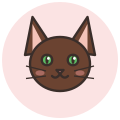
Ears like satellite dishes.
Oriental Shorthair
Also called Oriental, Foreign Shorthair, Foreign Type, Havana (UK name for the solid brown variety), Foreign White (UK name for the blue-eyed white variety)
From Developed in the United Kingdom from the 1950s by crossing Siamese with other cats to get the Siamese body in solid and patterned colours; the breed was then built up and first formally recognised as 'Oriental Shorthair' in the United States in the 1970s. Its Siamese ancestors trace back to Thailand.123
At a glance the quick version
Wikipedia gives males about 3.5-5.5 kg with females under 3.5 kg; Hill's gives males 8-12 lb (about 3.6-5.4 kg) and females under 8 lb (about 3.6 kg). GCCF gives an average of 8-14 lb (about 3.6-6.4 kg) without splitting by sex. Female left null as sources give only an upper limit.
Coat and looks how to spot one
very short, fine, glossy coat lying close to the body, with almost no undercoat
A long, slim and elegant cat with fine bones and firm, well-toned muscles, its shoulders no wider than its hips. The head is a long, clean wedge with a straight nose, leading out to very large, pointed ears set wide at the base, which give the breed its striking outline. The medium, almond-shaped eyes slant towards the nose and are usually a vivid green; white cats may have green, deep blue or one of each. The legs are long and slender with small oval paws, and the tail is very long, thin and whip-like. The coat is extremely short and satin-smooth, with a glossy sheen.5213
Personality what they are like
A lively, clever and talkative companion that bonds closely with its people and wants to be involved in whatever is going on. Orientals are curious, love interactive games and often learn to fetch, and many stay kitten-like and playful into adulthood. They enjoy conversation and attention, and some happily curl up on a lap despite their sleek, athletic look. They are sociable with families and usually thrive with company.2134
Daily activity how busy a day looks
High. These are agile jumpers that love heights, so provide cat trees, perches and shelves, plus daily interactive play such as fetch, wand toys and puzzle games. Many can be taught to walk on a harness and lead.413
Grooming and care the hands-on bits
Very little coat care needed. A weekly brush or rub with a soft glove keeps the short coat glossy, and most Orientals enjoy grooming as a moment of attention; they shed only lightly. The Oriental Longhair variety needs regular combing, although its silky coat has no woolly undercoat and resists tangles.214
Home where they are happiest
Adapts well to indoor or apartment living as long as there is vertical space to climb and perch, scratching posts, and plenty of toys and daily play with people.41
Food basics what goes in the bowl
A complete, balanced cat food suitable for its life stage, with measured portions to keep this slender, long-legged cat lean. Fresh water should always be available.4
Company who they like around
Very people-oriented and does best with an attentive household. GCCF notes Orientals do not tend to enjoy being the only animal and are happier with other cats or pets and people around them for company when owners are out.124
The story where it all began
Orientals are essentially Siamese cats without the restriction of pointed colouring. In Britain in 1951, Baroness von Ullmann began crossing chocolate-pointed Siamese with a non-pedigree black cat to produce solid-coloured cats with the fine 'foreign' body type, and in October 1952 the first modern chestnut brown cat, Elmtower Bronze Idol, was born; this colour became known as the Havana. Lilac cats followed, and in the 1960s breeders developed the blue-eyed Foreign White. To widen the palette, British breeders also brought in Russian Blues, British Shorthairs, Abyssinians and domestic shorthairs. In the early 1970s, American breeders such as Vicky and Peter Markstein imported solid and tabby foreign-type cats from British catteries including Angela Sayers' Solitaire and Patricia White's lines. Oriental Shorthairs International formed in 1973, CFA accepted the breed for registration in 1974 and granted championship status in 1977, added bicolours in 1985 and the longhair variety in 1988. The GCCF recognised the colours step by step, first under names like Havana and Foreign White, before grouping them under the Oriental name.132
Fun facts for the dinner table
- 1
Counting every colour, pattern and coat length, CFA says there are over 600 possible Oriental combinations, making it one of the most colour-varied breeds in the fancy.2
- 2
The very first modern Havana, a chestnut brown cat named Elmtower Bronze Idol, was born in Britain in October 1952.1
- 3
Unlike its blue-eyed Siamese cousins, a coloured Oriental is expected to have vivid green eyes; white Orientals may have blue, green or odd eyes.5
- 4
Many Orientals love retrieving and will play fetch like a dog.1
- 5
Orientals can often be trained to walk on a lead and harness.4
- 6
Orientals are judged together with Siamese in the same standard group by FIFe, reflecting their shared body type.5
Recognised by the official bits
- CFA
- Accepted for registration 1974, championship status 1977; bicolours added 1985; longhair variety added 19882
- GCCF
- Section 6 (Siamese & Oriental), Group 1; recognised colour by colour from the 1950s, starting with Havana, Oriental Lilac and Foreign White; bicolours 19971
- FIFe
- Fully recognised, Category 4 (code OSH), sharing a standard with Siamese, Balinese and Oriental Longhair6
- TICA
- Breed standard held3
- WCF
- Breed standard held3
The care rhythm Furry Diary remembers it for you
A typical home-care rhythm for a Oriental Shorthair. It is our own starting plan, not a vet's advice, and you can change every line in the app.
- Brushingevery week
- Nail trimevery 3 weeks
- Teeth brushingDaily brushing is idealevery 2 days
- Litter scoopevery day
- Litter changeevery week
- PlayAbout 60 minutes of play a dayevery day
- Flea, tick and worm protectionSchedule as your vet recommendsas your vet recommends
- Vet check-upSenior years usually start around age 11every year
You might also like
 Siamese
 Oriental Longhair
 Balinese
 Cornish Rex
 Peterbald
Like what we are building? Buy us a coffee.
The breed atlas is free for everyone, with a source on every fact, and it will never show ads. If it helped you, a small tip keeps the research going. Any amount is lovely, and no is a perfectly fine answer too.
Where this comes from
Every breed page shows where each fact comes from. If we got something wrong, sorry, we are pet people, not a science magazine. Tell us at support@furrydiary.app and we will fix it.
- Oriental - GCCF gccfcats.orgused for UK history, GCCF section, size, lifespan, colours, temperament, social needs, grooming
- Oriental - Cat Fanciers' Association cfa.orgused for CFA recognition, body, eyes, coat, colours, temperament, grooming
- Oriental Shorthair - Wikipedia en.wikipedia.orgused for origin, US history, recognition list, weight, colour count, temperament
- Oriental - Hill's Pet hillspet.comused for weight, lifespan, colours, activity, diet, grooming, lead training
- FIFe breed standard: Balinese, Siamese, Oriental Longhair, Oriental Shorthair fifeweb.orgused for body, head, eyes, coat, colours
- FIFe breeds list fifeweb.orgused for FIFe category and status
Checked 2026-09-30. Text is written in our own words from these sources.