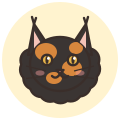
At a glance the quick version
TICA: males 8-12 lb, females 5-8 lb. Matures slowly, at around 18-24 months.
Coat and looks how to spot one
semi-long, fine, silky coat without a woolly undercoat
A slender, elegant cat built like a dancer, with fine bones, a long tubular body, a long wedge-shaped head and large ears. Its medium-length silky coat lies close and drapes over the body, ending in a plumed tail; some have ear tufts.321
Personality what they are like
An intelligent, sociable and talkative cat that loves attention and joins in with whatever its family is doing. It stays playful throughout life and bonds closely with its people.132
Daily activity how busy a day looks
High. A natural athlete that likes fetching, climbing and feline agility; needs toys and climbing places.1
Grooming and care the hands-on bits
Brush about once a week; the silky coat rarely tangles and sheds little. Weekly nail trims, ear checks and regular tooth brushing round out the routine.132
Home where they are happiest
A curious climber that benefits from cat trees, shelves and other enrichment.1
Company who they like around
Thrives on company and generally does better in a home with another cat than alone.12
The story where it all began
Oriental cats grew out of 1950s British breeding in which Siamese were crossed with Russian Blues, British Shorthairs, Abyssinians and domestic cats to create Siamese-type cats without the pointed pattern. These Orientals reached the United States in the 1970s, and the longhaired version, carrying a pair of recessive longhair genes, was accepted by the CFA as a division of the Oriental.134
Fun facts for the dinner table
- 1
Its huge colour range earned the Oriental family the nickname 'Ornamentals'.1
- 2
In 2011 a white Oriental Longhair named Harry won a lookalike contest against news anchor Anderson Cooper on his talk show.1
- 3
In Britain the breed used to be called the Angora.2
- 4
Many Oriental Longhairs take part in feline agility and enjoy playing fetch.1
Recognised by the official bits
- CFA
- Oriental Longhairs accepted 1988, when the breed name became simply 'Oriental'; shown as a separate longhair division (Wikipedia gives CFA recognition as 1995)3
- CFA (per Wikipedia)
- Recognised 19954
- TICA
- Recognised within the Siamese Breed Group1
- GCCF
- Recognised as the Oriental Longhair, formerly called Angora2
The care rhythm Furry Diary remembers it for you
A typical home-care rhythm for a Oriental Longhair. It is our own starting plan, not a vet's advice, and you can change every line in the app.
- Brushingevery 2 days
- Deshedding springBrush more while sheddingevery day
- Nail trimevery 3 weeks
- Teeth brushingDaily brushing is idealevery 2 days
- Litter scoopevery day
- Litter changeevery week
- PlayDaily playevery day
- Flea, tick and worm protectionSchedule as your vet recommendsas your vet recommends
- Vet check-upSenior years usually start around age 11every year
You might also like
 Oriental Shorthair
 Balinese
 Javanese
 Siamese
Like what we are building? Buy us a coffee.
The breed atlas is free for everyone, with a source on every fact, and it will never show ads. If it helped you, a small tip keeps the research going. Any amount is lovely, and no is a perfectly fine answer too.
Where this comes from
Every breed page shows where each fact comes from. If we got something wrong, sorry, we are pet people, not a science magazine. Tell us at support@furrydiary.app and we will fix it.
- Oriental Longhair - TICA tica.orgused for history, recognition, weight, coat, temperament, care, fun facts
- Oriental - GCCF gccfcats.orgused for former name, coat, lifespan
- Oriental - CFA cfa.orgused for CFA recognition, body, coat, temperament, grooming
- Oriental Shorthair - Wikipedia en.wikipedia.orgused for alternative CFA recognition date, longhair genetics
Checked 2026-09-30. Text is written in our own words from these sources.