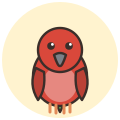
Red-rumped Parrot
Psephotus haematonotus
Also called Red-rumped parakeet, Redrump, Red-backed parrot, Grass parrot, Green leek
From South-eastern Australia, from southern Queensland through New South Wales to Victoria and South Australia, in open and riverside woodland, grassland, farmland and suburbs up to about 1,000 m.1
At a glance the quick version
Looks how to spot one
Feathered; slim, long-tailed parakeet
Males are a bright emerald green with a yellow belly and a bright red patch on the lower back that shows in flight. Hens are a softer olive-green with a green rump. One subspecies has paler, bluer tones.12
Personality what they are like
A lively ground-feeding parakeet with a cheerful whistled call. It is hardy and adaptable. It is best housed as a pair on its own, as it can be bossy toward other birds.21
Daily activity how busy a day looks
Most active at dawn and dusk. Needs space to fly: an indoor aviary at least 1.8 m long or a larger walk-in aviary. It is a keen chewer that likes plenty of wooden items to work on.12
Grooming and care the hands-on bits
Enjoys bathing, so provide water to bathe in. Supply plenty of chewable wood for enrichment.1
Home where they are happiest
An indoor aviary of at least 1.8 m or a bigger walk-in enclosure.1
Food basics what goes in the bowl
A small-seed mix with greens and a complete kibble. Wild birds eat grass and herb seeds and leaves, often bending seed stalks to the ground under their weight to reach the seeds.1
Company who they like around
Lives in pairs or small flocks in the wild. In aviaries it is usually kept as a pair, apart from other species.2
The story where it all began
John Gould described the species in 1837 from a bird collected in New South Wales. Its scientific name means roughly 'pebble-patterned, blood-backed'. The wild population recovered from a dip in the early 1900s and spread as land was opened up for farming after the 1950s.21
Fun facts for the dinner table
- 1
It feeds by landing on a small plant stem until it bends to the ground, then picks off the seeds.1
- 2
Aviculturists have produced more than 22 colour mutations.2
- 3
Its call is often written as 'chee chillip chee chillip'.2
- 4
Genetic studies show it is an early offshoot of the rosella family line and the only species in its genus.2
Recognised by the official bits
- IUCN Red List
- Least Concern; population size unknown but increasing.1
- CITES
- Appendix II.1
- Taxonomy
- Described by John Gould in 1837. Now the only member of its genus, Psephotus.2
The care rhythm Furry Diary remembers it for you
A typical home-care rhythm for a Red-rumped Parrot. It is our own starting plan, not a vet's advice, and you can change every line in the app.
- Fresh food and waterevery day
- Cage linerevery 2 days
- Full cleanevery week
- Bath offerevery 3 days
- Nails checkevery month
- Beak checkevery month
- Toy rotationevery week
- Out-of-cage timeAbout 2 hours a dayevery day
- Vet check-upevery year
You might also like
 Eastern Rosella
 Bourke's Parakeet
Like what we are building? Buy us a coffee.
The breed atlas is free for everyone, with a source on every fact, and it will never show ads. If it helped you, a small tip keeps the research going. Any amount is lovely, and no is a perfectly fine answer too.
Where this comes from
Every breed page shows where each fact comes from. If we got something wrong, sorry, we are pet people, not a science magazine. Tell us at support@furrydiary.app and we will fix it.
- Red-rumped Parrot - World Parrot Trust Parrot Encyclopedia parrots.orgused for size, weight, range, status, captive care, diet, fun facts
- Red-rumped parrot - Wikipedia en.wikipedia.orgused for history, taxonomy, weight, lifespan, mutations, temperament
Checked 2026-09-30. Text is written in our own words from these sources.