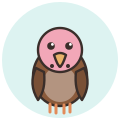
Bourke's Parakeet
Neopsephotus bourkii
Also called Bourke's parrot, Bourke's grass parakeet, Pink-bellied parakeet, Sundown parrot, Rosy Bourke (rosa mutation)
From Inland Australia, across the west, south-centre and east-centre of the continent, from coastal Western Australia to western Queensland and western New South Wales, in dry scrub country.1
At a glance the quick version
World Parrot Trust gives 40-50 g overall.
Looks how to spot one
Feathered; small, slim grass parakeet
A small, gently coloured parakeet. Wild-type birds are soft olive-brown above with a rose-pink belly, blue under the tail and a blue rump. Adult males have a blue band on the forehead, while hens are paler with little or no blue on the head.12
Personality what they are like
A calm, peaceful and quiet little parakeet that suits first-time bird keepers. It rarely talks. It is most lively around dawn and dusk.2
Daily activity how busy a day looks
Most active in the early morning and evening. It flies fast and low in the wild, so it needs space to fly: a walk-in aviary at least 2.1 m long, or an indoor aviary with climbing branches.12
Grooming and care the hands-on bits
Low-maintenance. Give climbing branches and safe seeding grasses to pick at. Offer the dusk and dawn quiet time it naturally prefers for activity.12
Home where they are happiest
A walk-in enclosure at least 2.1 m long, or an indoor aviary, furnished with safe seeding grasses and climbing branches.1
Food basics what goes in the bowl
A grass-seed eater. In the wild it takes grass seeds and shoots, herb seeds and seeds of Acacia and similar plants, feeding on the ground and in bushes. In captivity a small-seed mix with seeding grasses and greens fits its natural diet.12
Company who they like around
A social, nomadic bird that forms flocks; at waterholes in dry times up to 1,000 may gather. Usually kept in pairs or small groups.1
The story where it all began
Explorer Thomas Mitchell saw the bird in New South Wales in 1835 and named it after Sir Richard Bourke, the colony's governor at the time. John Gould described it scientifically in 1841, and it later received a genus of its own. The pink Rosy Bourke is now one of the best-known aviary varieties.2
Fun facts for the dinner table
- 1
It is sometimes called the 'sundown parrot' because it is most active at dusk and dawn.1
- 2
Up to 1,000 birds may gather at a single waterhole in dry periods.1
- 3
Its numbers seem to be rising, likely helped by water points built for livestock.1
- 4
The Rosy (rosa) mutation, with its pink plumage, is especially common in aviaries.2
Recognised by the official bits
- IUCN Red List
- Least Concern; fairly common and apparently increasing.1
- CITES
- Appendix II.1
- Taxonomy
- Described by John Gould in 1841. Moved into its own genus, Neopsephotus, in the 1990s.2
The care rhythm Furry Diary remembers it for you
A typical home-care rhythm for a Bourke's Parakeet. It is our own starting plan, not a vet's advice, and you can change every line in the app.
- Fresh food and waterevery day
- Cage linerevery 2 days
- Full cleanevery week
- Bath offerA shallow dish or gentle mistevery 3 days
- Nails checkevery month
- Toy rotationevery 2 weeks
- Out-of-cage timeAbout an hour a day, if tameevery day
- Vet check-upevery year
You might also like
 Scarlet-chested Parakeet
 Budgerigar
Like what we are building? Buy us a coffee.
The breed atlas is free for everyone, with a source on every fact, and it will never show ads. If it helped you, a small tip keeps the research going. Any amount is lovely, and no is a perfectly fine answer too.
Where this comes from
Every breed page shows where each fact comes from. If we got something wrong, sorry, we are pet people, not a science magazine. Tell us at support@furrydiary.app and we will fix it.
- Bourke's Parrot - World Parrot Trust Parrot Encyclopedia parrots.orgused for size, weight, lifespan, range, status, diet, social behaviour, aviary size, fun facts
- Bourke's parrot - Wikipedia en.wikipedia.orgused for history, taxonomy, sexed weights, lifespan, temperament, mutations
Checked 2026-09-30. Text is written in our own words from these sources.