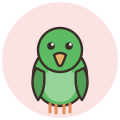
Maroon-bellied Conure
Pyrrhura frontalis
Also called Maroon-bellied parakeet, Reddish-bellied parakeet, Reddish-bellied conure, Brown-eared conure
From South-eastern South America: eastern and south-eastern Brazil, eastern Paraguay, north-eastern Argentina and Uruguay. It lives in woodland and forest edges and adapts well to parks and gardens.12
At a glance the quick version
Looks how to spot one
Feathered; small, slender Pyrrhura conure with a long tail
A small green conure with a scalloped, yellow-green barred chest and neck, a pale brownish ear patch and a thin dark red band above the black beak. A maroon patch on the belly and a maroon underside to the tail give it its name, and the flight feathers are blue on the outer edge.13
Personality what they are like
Maroon-bellied conures are friendly, bright and busy birds that often enjoy a cuddle and get along with several family members. They are among the quieter conures, chirping more than screaming, though they can still be shrill when excited. Speech is limited, but some learn a few simple chirped phrases.31
Daily activity how busy a day looks
Needs several hours outside the cage each day and a good range of toys to climb, chew and play with.3
Grooming and care the hands-on bits
Enjoys bathing, so offer a shallow dish or a light misting regularly. Provide bird-safe branches and toys for chewing.32
Home where they are happiest
A cage of at least about 51 x 51 x 91 cm (20 x 20 x 36 in); bigger is better. For aviary birds the World Parrot Trust suggests a flight at least 2 m long.32
Food basics what goes in the bowl
Wild birds eat fruit, flowers, Araucaria nuts and palm nuts. Pets take well to pellets, with about 30% fruit plus vegetables, leafy greens and a small-seed mix.123
Company who they like around
A flock bird, typically in groups of 6-12 in the wild. In the home it needs plenty of daily company and attention.23
The story where it all began
Louis Vieillot formally described the species in 1818, building on an illustration published by Francois Levaillant in 1801. Its species name frontalis refers to the dark band on its forehead. It is kept by bird keepers mostly as captive-bred birds.1
Fun facts for the dinner table
- 1
Wild flocks regularly visit gardens and city parks.2
- 2
A darker colour form once called Krieg's conure turned out to be a natural variation seen in about one in five birds in part of its range.1
- 3
It is often confused with the green-cheeked conure, which looks and behaves quite similarly.3
- 4
Its wild menu includes nuts from Araucaria (monkey-puzzle) trees.2
Recognised by the official bits
- IUCN Red List
- Least Concern; generally common.1
- CITES
- Appendix II.2
- Taxonomy
- Two subspecies: frontalis and chiripepe.1
The care rhythm Furry Diary remembers it for you
A typical home-care rhythm for a Maroon-bellied Conure. It is our own starting plan, not a vet's advice, and you can change every line in the app.
- Fresh food and waterevery day
- Cage linerevery 2 days
- Full cleanevery week
- Bath offerevery 3 days
- Nails checkevery month
- Beak checkevery month
- Toy rotationevery week
- Out-of-cage timeAbout 2 hours a dayevery day
- Vet check-upevery year
You might also like
 Green-cheeked Conure
 Crimson-bellied Conure
 Sun Conure
Like what we are building? Buy Archy a bone.
All of this is free for everyone, with a source on every fact, and it will never show ads. It was a big job to build, so if it helped you, buy Archy a bone. Any amount is lovely, and no is a perfectly fine answer too.
Archy is our Australian Cattle Dog and chief taste tester. Tips go to 4V3D OÜ, the small family studio behind Furry Diary.
Where this comes from
Every breed page shows where each fact comes from. If we got something wrong, sorry, we are pet people, not a science magazine. Tell us at support@furrydiary.app and we will fix it.
- Maroon-bellied parakeet - Wikipedia en.wikipedia.orgused for range, taxonomy, size, plumage, history, temperament
- Maroon-bellied Conure - World Parrot Trust parrots.orgused for range, weight, lifespan, care, diet, behaviour
- Maroon-Bellied Conure - Singing Wings Aviary singing-wings-aviary.comused for pet temperament, cage size, bathing, mutations
Checked 2026-09-30. Text is written in our own words from these sources.