Walking sunshine, with volume.
Sun Conure
Aratinga solstitialis
Also called Sun Parakeet, Yellow Conure, Sunny
From North-eastern South America: the northern Brazilian state of Roraima, southern and western Guyana, the far south of Suriname and southern French Guiana, with recent reports near Santa Elena de Uairén in Venezuela. It lives below about 1,200 m in dry savanna woodland, open savanna edged by taller forest, riverbanks, forested valleys, palm groves and secondary growth.1234
At a glance the quick version
Looks how to spot one
Feathered; medium-small parrot with a long pointed tail
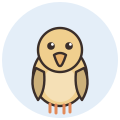
A compact, long-tailed conure dressed mostly in vivid golden yellow. The face and belly glow orange, with reddish tones around the ears, while the flight feathers and tail tips are green shading to blue. The bill is black, the legs grey, and a bare pale ring surrounds each dark eye. Males and females look almost identical. Youngsters start out largely green, much like a jandaya, and reach their full sunset colouring at around two years old.1235
Personality what they are like
Sun conures are outgoing, comic little parrots that thrive on company. Hand-raised birds tend to be cuddly and devoted, learn tricks readily and often enjoy music, sometimes bobbing or singing along. They are a vocal species with a shrill contact call they use a lot, especially when they feel alone. Most learn only a handful of words, so they suit owners who enjoy a lively, chatty companion rather than a quiet one.51
Daily activity how busy a day looks
High. Wild flocks cover many kilometres a day in fast, direct flight. At home a sun conure needs daily time out of the cage to fly or climb, plus plenty of toys, foraging puzzles and safe items to shred.135
Grooming and care the hands-on bits
Keep a steady supply of safe chew toys, since conures have busy beaks. Offer regular chances to bathe or be misted, and have nails checked as part of routine avian vet visits. Expect some noise every day and plan for a long-term commitment of 15 years or more.5
Home where they are happiest
A roomy, sturdy parrot cage with several natural wood perches of different thicknesses, rotating toys and foraging items, placed in a busy family room. Aviary birds need a flight of at least 2-3 m. Daily supervised out-of-cage play is important.256
Food basics what goes in the bowl
In the wild they eat fruit, berries, flowers, buds, nuts, seeds, legume pods and some insects. Pet birds do well on a balanced pelleted or other manufactured parrot diet as the base, topped up daily with a wide range of fresh vegetables and fruit.1235
Company who they like around
Very social. In the wild they travel in flocks of about 3-30 birds and form monogamous pairs. A pet needs lots of daily interaction and does not like being left alone for long; they can share space platonically with other Aratinga conures, but mixed-species breeding is not advised.135
The story where it all began
Linnaeus described the sun conure in 1758 under the name Psittacus solstitialis, a Latin nod to the summer sun that matches its golden feathers. It was later placed in the genus Aratinga, where it sits at the centre of a small group of closely related yellow-and-orange parakeets: the jandaya, golden-capped and sulphur-breasted parakeets were all once counted as its subspecies, and the sulphur-breasted form only gained wide recognition as a separate species in 2005. Its bright colours and lively character made it a favourite in the international pet trade, and large numbers were exported from Guyana; over 20,000 went to Singapore alone in 2005-2006. Import bans on wild birds by the United States (1992), Australia (1995) and the European Union (2005) shifted the pet supply towards captive breeding, and today far more sun conures live in homes and aviaries than in the wild. The species was uplisted to Endangered, and a small population in Guyana has shown signs of recovery.12
Fun facts for the dinner table
- 1
Its species name, solstitialis, refers to the summer solstice or sunshine, a fitting label for its golden plumage.1
- 2
It is the closest living relative of the extinct Carolina parakeet; the two lines split roughly 3 million years ago.1
- 3
Despite weighing only around 110 g, a sun conure's calls have been measured at over 120 decibels.1
- 4
Chicks are mostly green and look a lot like jandaya conures; the full orange-and-yellow colouring takes about two years to develop.5
- 5
More sun conures now live in captivity than in the wild.1
- 6
Near Karasabai in Guyana they feed on monkey brush flowers, where their orange and yellow colouring helps them blend in.1
- 7
Like many parrots they use their feet like hands to hold and inspect food, and their beak as a third limb when climbing.1
Recognised by the official bits
- IUCN Red List
- Endangered, uplisted after a very rapid fall in numbers over three decades.2
- CITES
- Listed on Appendix II.2
- Taxonomy
- Named Psittacus solstitialis by Linnaeus in 1758 in the 10th edition of Systema Naturae, later moved to Aratinga. Monotypic, but it heads the Aratinga solstitialis complex together with the jandaya, golden-capped and sulphur-breasted parakeets, which were once treated as its subspecies.1
How many Fewer than 2,500 wild individuals (World Parrot Trust gives 1,000-2,499 mature individuals, decreasing).12
The care rhythm Furry Diary remembers it for you
A typical home-care rhythm for a Sun Conure. It is our own starting plan, not a vet's advice, and you can change every line in the app.
- Fresh food and waterevery day
- Cage linerevery 2 days
- Full cleanevery week
- Bath offerevery 3 days
- Nails checkevery month
- Beak checkevery month
- Toy rotationevery week
- Out-of-cage timeAbout 2 hours a dayevery day
- Vet check-upevery year
You might also like
 Jenday Conure
 Green-cheeked Conure
Like what we are building? Buy us a coffee.
The breed atlas is free for everyone, with a source on every fact, and it will never show ads. If it helped you, a small tip keeps the research going. Any amount is lovely, and no is a perfectly fine answer too.
Where this comes from
Every breed page shows where each fact comes from. If we got something wrong, sorry, we are pet people, not a science magazine. Tell us at support@furrydiary.app and we will fix it.
- Sun parakeet - Wikipedia en.wikipedia.orgused for taxonomy, range, size, lifespan, behaviour, breeding, history, fun facts, population
- Sun Conure - World Parrot Trust Parrot Encyclopedia parrots.orgused for status, CITES, population, habitat, weight, aviary size, diet, threats
- Aratinga solstitialis - Animal Diversity Web (University of Michigan) animaldiversity.orgused for weight, length, lifespan, flock size, diet, reproduction
- Sun Parakeet - eBird (Cornell Lab of Ornithology) ebird.orgused for identification, habitat, flocking behaviour
- Sun Conure - Lafeber Company lafeber.comused for temperament, pet care, diet, lifespan, juvenile colouring
- RSPCA - Pet bird environment rspca.org.ukused for general cage and perch guidance
Checked 2026-09-30. Text is written in our own words from these sources.