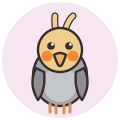
Whistles the hits.
Cockatiel
Nymphicus hollandicus
Also called Quarrion, Weero, Weiro, Tiel
From Mainland Australia. Wild birds range irregularly across the dry interior in every mainland state and territory, but not Tasmania, and stay away from the lush south-west and south-east corners and the harshest deserts. They favour semi-arid open woodland, acacia scrub, river red gum and coolibah country, grassland with scattered trees and farmland, always within reach of water.123
At a glance the quick version
Looks how to spot one
Feathered; slim grey parrot with a tall wispy crest and a long pointed tail
The smallest member of the cockatoo family, with a slender build and a long tapering tail that accounts for about half of its total length and fans out in flight. The natural colouring is a soft brownish grey with a bold white panel on each wing and a round orange patch on each cheek. Adult males have a bright yellow face and crest and stronger orange cheeks, while females keep a greyer face and show fine barring under the tail. Young birds of both sexes look like females until their first moult at around six to nine months. The thin, gently curved crest moves up and down with the bird's mood.1246
Personality what they are like
Cockatiels are friendly, curious and a bit comical, and tend to form a close bond with their favourite person. Many enjoy perching on a shoulder and having the head and cheek feathers gently scratched, which mirrors how wild pairs preen each other. They prefer chirping and whistling to loud screeching, which is one reason they suit flats and first-time bird keepers. Whistling tunes comes more naturally to them than talking; some birds, usually males, learn a few words or phrases, and some copy household sounds or sing along with songs. In the wild they are shy birds that rely on speed and camouflage rather than confrontation, so a calm home suits them well.514
Daily activity how busy a day looks
A strong, fast flyer that benefits from regular, supervised time out of the cage every day, in a room made safe and away from other pets. Cockatiels are natural ground foragers, so scattering treats on paper on the cage floor or a play area gives them a satisfying way to search for food.54
Grooming and care the hands-on bits
Cockatiels produce powder down, a fine dust from their feathers, so regular cleaning around the cage and a well-ventilated room help. Offer regular chances to bathe or a light misting, keep perches of varied thickness to wear the nails naturally, and rotate toys to keep the bird busy. Keep the cage floor clean, as the bird spends time foraging there.15
Home where they are happiest
A cage large enough for the bird to stretch and flap its wings fully, with several perches, food and water bowls and toys. A wide front door helps, because cockatiels can be flighty and may panic if squeezed through a small opening. Place the cage in a lived-in room so the bird is part of family life.5
Food basics what goes in the bowl
In the wild cockatiels eat mostly small seeds gathered on the ground, especially acacia and grass seeds, plus crops such as wheat, sunflower and sorghum and some fruit and berries. At home a balanced diet is a good-quality pellet made for small parrots as the base, fresh vegetables and some fruit, and a small-seed mix given in moderation, with sunflower kept as an occasional treat. Fresh water every day.2453
Company who they like around
A very social flock bird that in the wild lives in groups from a handful to thousands, with pairs staying together all year. A pet cockatiel needs daily company, whether that is being talked to, gentle petting or simply sharing a room with its people, and many do well with another cockatiel for company.345
The story where it all began
Cockatiels come from the dry interior of Australia, where they are also known as quarrion and weero. European naturalists described the bird in the late 1700s, first Gmelin in 1788 and then Kerr in 1792, whose species name hollandicus refers to New Holland, the old Dutch name for Australia. In 1832 Wagler gave it its own genus, Nymphicus, a nod to the mythical nymphs, reflecting how charming early Europeans found it. Because it breeds readily in captivity, the cockatiel became one of the most widely kept pet parrots in the world and costs less than most other parrots. Breeders in the 20th century began fixing colour mutations: pied appeared in California in 1949, cinnamon in the 1950s, lutino in 1958 and pearl in 1967, and today more than twenty mutations are established, several found only in Australia. Modern genetic studies confirmed that the cockatiel, despite its parakeet-like shape, is a true cockatoo placed in its own subfamily.15
Fun facts for the dinner table
- 1
It is the smallest member of the cockatoo family and the only species in its genus, Nymphicus.1
- 2
The crest works like a mood signal: straight up when startled or excited, gently angled when relaxed, and flattened when the bird feels defensive.1
- 3
Cockatiels are the only cockatoos that can breed before the end of their first year, and in the wild breeding is set off by seasonal rain.1
- 4
The oldest confirmed cockatiel was reported to be 36 years old.4
- 5
They can fly at more than 40 miles per hour (about 64 km/h) and use speed rather than fighting to escape predators.4
- 6
The long tail makes up about half of the bird's length and spreads into a fan in flight.4
- 7
The first colour mutation, pied, appeared in California in 1949; today over twenty mutations exist.1
- 8
Their best-known flight call is a rolling whistled 'queel queel' or 'wee-rooo'.3
Recognised by the official bits
- IUCN Red List
- Least Concern. The wild population is described as abundant and stable, and seems to have gained from farm water points across its range.2
- American Cockatiel Society
- Founded in 1976 and describes itself as the oldest international cockatiel society in America. It serves both pet keepers and exhibitors and holds specialty shows.7
- Taxonomy
- Described by Gmelin in 1788 as Psittacus novaehollandiae and by Kerr in 1792 as Psittacus hollandicus. Wagler placed it in its own genus Nymphicus in 1832. Molecular work puts it in the cockatoo family Cacatuidae, in its own subfamily Nymphicinae.1
The care rhythm Furry Diary remembers it for you
A typical home-care rhythm for a Cockatiel. It is our own starting plan, not a vet's advice, and you can change every line in the app.
- Fresh food and waterevery day
- Cage linerevery 2 days
- Full cleanevery week
- Bath offerevery 3 days
- Nails checkevery month
- Beak checkevery month
- Toy rotationevery week
- Out-of-cage timeAbout 2 hours a dayevery day
- Vet check-upevery year
You might also like
 Budgerigar
 Galah
Galah Bourke's Parakeet
Like what we are building? Buy Archy a bone.
All of this is free for everyone, with a source on every fact, and it will never show ads. It was a big job to build, so if it helped you, buy Archy a bone. Any amount is lovely, and no is a perfectly fine answer too.
Archy is our Australian Cattle Dog and chief taste tester. Tips go to 4V3D OÜ, the small family studio behind Furry Diary.
Where this comes from
Every breed page shows where each fact comes from. If we got something wrong, sorry, we are pet people, not a science magazine. Tell us at support@furrydiary.app and we will fix it.
- Cockatiel - Wikipedia en.wikipedia.orgused for taxonomy, range, plumage, mutations, crest behaviour, lifespan, breeding, history
- Cockatiel - World Parrot Trust Parrot Encyclopedia parrots.orgused for length, weight, habitat, wild diet, captive diet, status
- Cockatiel - BirdLife Australia birdlife.org.auused for distribution, habitat, flocking, calls, wild diet
- Nymphicus hollandicus - Animal Diversity Web (University of Michigan) animaldiversity.orgused for weight, length, lifespan, record age, flight speed, social behaviour, diet
- Cockatiel - Lafeber Company lafeber.comused for pet care, cage, diet, personality, vocal abilities, colour varieties, name origin
- Cockatiel - eBird (Cornell Lab of Ornithology) ebird.orgused for identification and call
- American Cockatiel Society acstiels.comused for recognition by a specialist society
Checked 2026-09-30. Text is written in our own words from these sources.