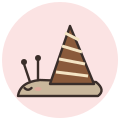
Not furry either, still lovely.
Nassarius Snail
Nassarius spp.
Also called Nassa mud snail, Dog whelk
From Found in seas worldwide, living on intertidal and shallow subtidal mud and sand flats.1
At a glance the quick version
Maximum size about 1/2 inch for the aquarium form; the genus covers minute to medium-sized snails.
Looks how to spot one
Spiral shell
A small sea snail with a rounded, spiral shell shaped a little like an olive stone, with a cone-like spire and a notch for its long breathing tube (siphon). Shell sculpture varies between species.12
Personality what they are like
A peaceful little scavenger that spends much of its time buried in the sand with just its siphon showing. When it smells food it pops out and glides over the bottom surprisingly quickly to find it.12
Daily activity how busy a day looks
Mostly hidden under the sand, emerging in bursts to forage when food is in the water.12
Grooming and care the hands-on bits
Acclimate slowly and keep water quality stable with low nitrate; copper-based treatments must not be used in its tank.2
Home where they are happiest
An established marine tank with live rock and a deep, soft sand bed to burrow in. Stable, fully marine water at about 22-26 C, pH 8.1-8.4, salinity (specific gravity) 1.023-1.025 and dKH 8-12.2
Food basics what goes in the bowl
A scavenger that eats leftover food, detritus and carrion such as dead fish; in the wild it also feeds on crabs and other dead animals.12
Company who they like around
Peaceful with fish and other invertebrates and can be kept in groups as part of a clean-up crew.2
The story where it all began
The genus was named by Dumeril in 1806 and has grown to include hundreds of species found on sandy and muddy shores around the world. In the aquarium hobby, species such as Nassarius vibex became popular for keeping sand beds turned over and free of leftover food.1
Fun facts for the dinner table
- 1
Shells of Nassarius gibbosulus were made into beads around 100,000 years ago, among the oldest known personal ornaments.1
- 2
It waits buried in the sand with only its siphon sticking out, 'sniffing' the water for food.1
- 3
More than 1,000 species names have been placed in this genus over the years.1
- 4
In the UK these snails are known as dog whelks, while in the USA they are called nassa mud snails.1
Recognised by the official bits
- Taxonomy (via Wikipedia)
- Genus Nassarius, named by Dumeril in 1806 (family Nassariidae). More than 1,000 names have been placed in the genus over time, though many are now treated as synonyms.1
The care rhythm Furry Diary remembers it for you
A typical home-care rhythm for a Nassarius Snail. It is our own starting plan, not a vet's advice, and you can change every line in the app.
- FeedingDepends on species, many feed from the light and the watervaries
- Salinity checkevery week
- Water testevery week
- Top-upTop up evaporation with fresh RO water, not salt waterevery day
- Water changeAbout 10 to 20% of the waterevery 2 weeks
- Light checkevery month
You might also like
 Cerith Snail
 Fighting Conch
Like what we are building? Buy us a coffee.
The breed atlas is free for everyone, with a source on every fact, and it will never show ads. If it helped you, a small tip keeps the research going. Any amount is lovely, and no is a perfectly fine answer too.
Where this comes from
Every breed page shows where each fact comes from. If we got something wrong, sorry, we are pet people, not a science magazine. Tell us at support@furrydiary.app and we will fix it.
- Nassarius (Wikipedia) en.wikipedia.orgused for names, range, shell, behaviour, diet, taxonomy, history, fun facts
- Nassarius Snail (LiveAquaria) liveaquaria.comused for size, temperament, water parameters, habitat and care
Checked 2026-09-30. Text is written in our own words from these sources.