At a glance the quick version
Maximum shell size about 15 cm; the smallest of the giant clams.
Looks how to spot one
Thick folded shell with a brilliant mantle
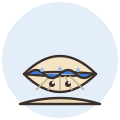
A small giant clam with two heavy, wavy-edged valves that are greyish white outside, sometimes tinged orange or yellow. Open, it shows a mantle in blue, green, purple, gold, orange or brown, often marked with spots or stripes and lined with tiny eyes.12
Personality what they are like
Peaceful and undemanding of tankmates; once it chooses a spot it attaches firmly and should not be moved.3
Daily activity how busy a day looks
Sessile; in the wild it bores into coral heads and rock until only its mantle shows.13
Grooming and care the hands-on bits
Needs strong lighting and stable reef water. Pick gentle tankmates such as gobies, cardinalfish and small wrasses that leave the mantle alone.3
Home where they are happiest
A reef tank of at least about 75 L (20 US gal), placed on rock in the middle to upper zone. Retail guidance: 24-27 C, pH 8.1-8.4, specific gravity 1.023-1.025, gentle to moderate flow and high light.3
Food basics what goes in the bowl
Mostly fed by the algae living in its mantle, which make food from light, plus some filter feeding.23
Company who they like around
Does not need company; choose gentle tankmates that leave its mantle alone.13
The story where it all began
Jean-Baptiste Lamarck described it in 1819. Its habit of drilling into coral and its jewel-like mantle have made it a prized aquarium clam, with farmed animals now widely available.13
Fun facts for the dinner table
Recognised by the official bits
- Taxonomy (via Wikipedia)
- Described by Lamarck in 1819; family Cardiidae, subfamily Tridacninae.1
- IUCN Red List
- Least Concern.1
- CITES (via SeaLifeBase)
- Appendix II.2
The care rhythm Furry Diary remembers it for you
A typical home-care rhythm for a Crocea Clam. It is our own starting plan, not a vet's advice, and you can change every line in the app.
- FeedingDepends on species, many feed from the light and the watervaries
- Salinity checkevery week
- Water testevery week
- Top-upTop up evaporation with fresh RO water, not salt waterevery day
- Water changeAbout 10 to 20% of the waterevery 2 weeks
- Light checkevery month
You might also like
 Maxima Clam
Like what we are building? Buy Archy a bone.
All of this is free for everyone, with a source on every fact, and it will never show ads. It was a big job to build, so if it helped you, buy Archy a bone. Any amount is lovely, and no is a perfectly fine answer too.
Archy is our Australian Cattle Dog and chief taste tester. Tips go to 4V3D OÜ, the small family studio behind Furry Diary.
Where this comes from
Every breed page shows where each fact comes from. If we got something wrong, sorry, we are pet people, not a science magazine. Tell us at support@furrydiary.app and we will fix it.
- Tridacna crocea (Wikipedia) en.wikipedia.orgused for names, range, size, shell and mantle, IUCN, history
- Tridacna crocea (SeaLifeBase) sealifebase.seused for size, depth, temperature, range, CITES
- Crocea Clam (Saltwaterfish.com) saltwaterfish.comused for aquarium care, water parameters, tank size, tankmates
Checked 2026-09-30. Text is written in our own words from these sources.