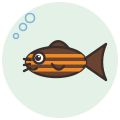
Not furry, but we like them anyway.
Striped Raphael Catfish
Platydoras armatulus (Valenciennes, 1840)
Also called Southern striped Raphael, Talking catfish, Chocolate doradid, Chocolate catfish, Thorny catfish
From South America: the Amazon, Paraguay-Parana and lower Orinoco basins, often over sandy or soft river bottoms.12
At a glance the quick version
Looks how to spot one
Armoured thorny catfish
A stocky catfish with a row of small curved bony spines along each side and very stiff pectoral fin spines. Its dark body carries a bright pale stripe that runs from the head along the flank.1
Personality what they are like
Calm, unaggressive and fairly secretive, it spends the day tucked away and comes out after dark.31
Daily activity how busy a day looks
Not very active; mainly a night-time forager that burrows into soft bottoms.31
Grooming and care the hands-on bits
Do not use a net, as its spines snag easily; move it with a container instead. Provide caves and a soft sandy bottom.13
Home where they are happiest
Tropical water of 24 to 30 C, pH 5.8 to 7.5 and hardness 2 to 20 dGH, in a tank with a base of at least 120 x 30 cm.3
Food basics what goes in the bowl
Omnivore: sinking pellets as a staple plus bloodworm and small earthworms, fed after lights out. In the wild it eats molluscs, crustaceans and organic debris.31
Company who they like around
Gets on with medium to large peaceful fish and tolerates its own kind in groups; very small fish may be eaten.31
The story where it all began
Valenciennes described it in 1840, and for many years it was mixed up with Platydoras costatus. It has been a long-standing favourite in the aquarium hobby, where nearly all fish are wild-caught.1
Fun facts for the dinner table
- 1
Its 'talking' sounds come from grinding its pectoral spines, amplified by the swim bladder.3
- 2
Young fish have been seen cleaning larger predatory fish, and their stripes may act as a 'cleaner' badge.1
- 3
Unusually large individuals up to about 43 cm have been reported from the Tocantins-Araguaia basin.1
- 4
In the wild it burrows into soft river bottoms and is often found over sand.1
Recognised by the official bits
- IUCN Red List
- Least Concern (assessed 5 August 2020)2
- Taxonomy
- Described by Valenciennes in 1840 as Doras armatulus; long confused with Platydoras costatus1
- Family
- Doradidae (thorny catfishes)2
The care rhythm Furry Diary remembers it for you
A typical home-care rhythm for a Striped Raphael Catfish. It is our own starting plan, not a vet's advice, and you can change every line in the app.
- Feedingevery day
- Water changeAbout 30 to 50% of the waterevery week
- Water testevery week
- Filter rinseevery 2 weeks
You might also like
 Spotted Raphael Catfish
Like what we are building? Buy us a coffee.
The breed atlas is free for everyone, with a source on every fact, and it will never show ads. If it helped you, a small tip keeps the research going. Any amount is lovely, and no is a perfectly fine answer too.
Where this comes from
Every breed page shows where each fact comes from. If we got something wrong, sorry, we are pet people, not a science magazine. Tell us at support@furrydiary.app and we will fix it.
- Wikipedia: Platydoras armatulus en.wikipedia.orgused for names, distribution, appearance, diet, behaviour, history
- FishBase: Platydoras armatulus fishbase.seused for size, IUCN, family
- Seriously Fish: Platydoras armatulus seriouslyfish.comused for tank size, water parameters, diet, compatibility, sound production
Checked 2026-09-30. Text is written in our own words from these sources.