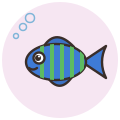
Not furry, but we like them anyway.
Sparkling Gourami
Trichopsis pumila (Arnold, 1936)
Also called Pygmy gourami, Ctenops pumilus (original name)
From Southeast Asia: the lower Mekong basin in Laos, Vietnam, Cambodia and Thailand plus peninsular Thailand, in still or slow lowland waters such as swamp forest, paddy fields, canals and ditches with dense plants.12
At a glance the quick version
Looks how to spot one
Scaled, small arrow-shaped labyrinth fish
A tiny, arrowhead-shaped gourami with one solid dark stripe along the side and a second row of dark blotches above it. Under good light its body and fins shimmer with red, green and blue, and its eyes can look bright blue. Males are more vivid and have longer fins than females.13
Personality what they are like
A small, peaceful fish that is a little shy. Males display to each other and to females with fin-spreading and soft croaks.13
Daily activity how busy a day looks
Moves calmly among plants, mostly in the middle and upper water, and takes air from the surface.13
Grooming and care the hands-on bits
A well-planted tank with surface cover and gentle water flow, plus regular partial water changes.1
Home where they are happiest
Tank with a base of at least 45 x 30 cm (about 40 litres). Temperature 22-28 °C, pH 5.0-7.5, hardness 1-12 dGH.1
Food basics what goes in the bowl
Eats small insects and invertebrates in nature. Accepts dried foods, but give plenty of small live or frozen foods such as daphnia, brine shrimp or bloodworm.12
Company who they like around
Keep as a pair or small group with other peaceful, small fish like small cyprinids or loaches. Very small shrimp may be eaten.1
The story where it all began
J. P. Arnold described it in 1936 under the name Ctenops pumilus. It later moved to Trichopsis and became a popular choice for small planted aquariums.3
Fun facts for the dinner table
- 1
Males and females 'croak' using a special mechanism in the pectoral fins, which you can sometimes hear outside the tank.1
- 2
It is one of the smallest gouramis, reaching only about 4 cm.1
- 3
It lives happily in low-oxygen places like rice paddies thanks to its air-breathing labyrinth organ.3
- 4
Males build small bubble nests, often under leaves or in tubes, and guard the eggs.1
Recognised by the official bits
- IUCN Red List
- Least Concern (assessed 13 March 2011)2
- Taxonomy
- Originally described as Ctenops pumilus by J. P. Arnold in 19363
The care rhythm Furry Diary remembers it for you
A typical home-care rhythm for a Sparkling Gourami. It is our own starting plan, not a vet's advice, and you can change every line in the app.
- FeedingSmall amounts once or twice a dayevery day
- Temperature checkevery day
- Water changeAbout 25% of the waterevery week
- Water testevery week
- Glass cleanevery week
- Filter rinseRinse in old tank water, never tap waterevery month
You might also like
 Honey Gourami
 Licorice Gourami
Like what we are building? Buy Archy a bone.
All of this is free for everyone, with a source on every fact, and it will never show ads. It was a big job to build, so if it helped you, buy Archy a bone. Any amount is lovely, and no is a perfectly fine answer too.
Archy is our Australian Cattle Dog and chief taste tester. Tips go to 4V3D OÜ, the small family studio behind Furry Diary.
Where this comes from
Every breed page shows where each fact comes from. If we got something wrong, sorry, we are pet people, not a science magazine. Tell us at support@furrydiary.app and we will fix it.
- Seriously Fish: Trichopsis pumila (Sparkling Gourami) seriouslyfish.comused for standard length, native range, habitat, tank size, temperature, pH, hardness, diet, compatibility, sexing, breeding
- FishBase: Trichopsis pumila, Pygmy gourami fishbase.seused for max length, distribution, habitat, water ranges, IUCN status, uses, breeding biology, author and year
- Wikipedia: Pygmy gourami en.wikipedia.orgused for other names, description, taxonomy and history, fun facts
Checked 2026-09-30. Text is written in our own words from these sources.