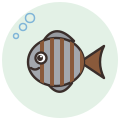
Not furry, but we like them anyway.
Sailfin Tang
Zebrasoma velifer (Bloch, 1795)
Also called Pacific sailfin tang, Sailfin surgeonfish, Purple sailfinned tang
From Eastern Indian Ocean and Pacific: from Christmas Island and the East Indies to the South China Sea, Hawaii and the Pitcairn Islands, north to Japan and south to Australia.12
At a glance the quick version
Maximum length.
Maximum reported age.
Looks how to spot one
Scaled, disc-shaped surgeonfish
A round, flat fish that can raise enormously tall dorsal and anal fins, making it look much bigger than it is. The body carries wide greyish-brown bands separated by thin yellow bars, the pale head is dotted with yellow, and a dark band crosses the eye. Young fish are much more yellow than adults.21
Personality what they are like
A calm, stately cruiser, usually seen alone or in pairs. It shows off by raising its huge fins, which also help it look larger to other fish.2
Daily activity how busy a day looks
Active through the day, gliding around lagoons and outer reefs to graze. Being a large tang, it needs long open swimming space.12
Grooming and care the hands-on bits
Marine reef fish for a mature saltwater aquarium. Typical reef-tank conditions are 24-27 C, salinity 1.022-1.025 specific gravity and pH around 8.2, which sits within the 24-28 C water it lives in on the reef. Keep water quality stable and offer algae-based meals every day. The blade-like tail spines are sharp, so move it with a net or container rather than bare hands.31
Home where they are happiest
Found in lagoon and outer reef areas, often in sheltered shallow spots, at about 2-30 m and down to 45 m. A large reef aquarium with open water and plenty of rock suits it. No minimum tank volume from a primary source was found.12
Food basics what goes in the bowl
Grazes mainly on leafy macroalgae. In aquariums offer a mostly plant-based menu of marine algae and seaweed.12
Company who they like around
The story where it all began
Marcus Elieser Bloch described the species in 1795 as Acanthurus velifer, a name referring to its sail-like dorsal fin. When the genus Zebrasoma was set up in 1839, this fish became its type species.2
Fun facts for the dinner table
Recognised by the official bits
- IUCN Red List
- Least Concern (assessed 7 May 2010)1
- Taxonomy
- Family Acanthuridae; described by Marcus Elieser Bloch in 1795 as Acanthurus velifer; type species of the genus Zebrasoma2
The care rhythm Furry Diary remembers it for you
A typical home-care rhythm for a Sailfin Tang. It is our own starting plan, not a vet's advice, and you can change every line in the app.
- FeedingSmall amounts once or twice a dayevery day
- Temperature checkevery day
- Salinity checkevery week
- Top-upTop up evaporation with fresh RO water, not salt waterevery day
- Water testevery week
- Water changeAbout 10 to 20% of the waterevery 2 weeks
- Glass cleanevery week
You might also like
 Yellow Tang
 Purple Tang
 Scopas Tang
Like what we are building? Buy us a coffee.
The breed atlas is free for everyone, with a source on every fact, and it will never show ads. If it helped you, a small tip keeps the research going. Any amount is lovely, and no is a perfectly fine answer too.
Where this comes from
Every breed page shows where each fact comes from. If we got something wrong, sorry, we are pet people, not a science magazine. Tell us at support@furrydiary.app and we will fix it.
- FishBase: Zebrasoma velifer summary fishbase.seused for distribution, depth, length, age, diet, temperature, IUCN status, spawning
- Wikipedia: Sailfin tang en.wikipedia.orgused for names, description, behaviour, taxonomy
- Wikipedia: Reef aquarium en.wikipedia.orgused for general reef aquarium water parameters
Checked 2026-09-30. Text is written in our own words from these sources.