At a glance the quick version
Looks how to spot one
Small, elongated reef basslet with a two-tone body
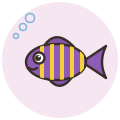
A slender little fish painted in two halves: the front glows in violet to deep purple, which melts into bright golden yellow toward the tail. A thin black stripe runs through the eye, and a small black spot sits near the front of the dorsal fin. Few aquarium fish show such a clean, striking split of colours.23
Personality what they are like
Generally peaceful with other fish but likes to claim a favourite cave or ledge as its own home, which it will defend. It tends to stay close to its shelter and shoots back inside if something startles it, then soon pops out again.21
Daily activity how busy a day looks
A moderately active fish that hangs and hovers near rockwork rather than cruising the open tank. It needs plenty of caves, overhangs and crevices to explore and use as a base.12
Grooming and care the hands-on bits
A hardy, beginner-friendly marine fish. Keep the saltwater stable: about 22 to 27 °C (72 to 78 °F), pH 8.1 to 8.4 and specific gravity 1.020 to 1.025, with regular partial water changes.21
Home where they are happiest
A saltwater aquarium of at least about 30 US gallons (roughly 115 L) with lots of live rock arranged into caves and ledges. In the wild it lives on reefs from about 1 to 60 m deep, usually in caves or under overhangs.21
Food basics what goes in the bowl
A plankton eater that feeds on zooplankton and small crustaceans, and it will also pick parasites off other fish. In the aquarium it readily takes frozen foods such as brine shrimp and marine pellets.21
Company who they like around
Usually kept on its own or as a pair. It mixes well with other peaceful community reef fish as long as it has its own cave to call home.2
The story where it all began
The royal gramma was named in 1868 by Felipe Poey, the Cuban zoologist who spent much of his life cataloguing the fishes of Cuba and later wrote a 20-volume work on them. Poey created the genus Gramma at the same time, with this fish as its type species. The genus has since grown to five species, all small, two-toned basslets from the western Atlantic and Caribbean, the most recent added in 2010. With its eye-catching purple and gold colours, peaceful nature and hardiness, the royal gramma became a long-standing favourite in the marine aquarium trade, where it is commonly recommended to newcomers.3421
Fun facts for the dinner table
- 1
It likes to keep its belly toward the nearest surface, so under a ledge it happily swims upside down. That is perfectly normal for this fish.2
- 2
It works part time as a cleaner, picking tiny parasites off other fish.1
- 3
Males build their nests in small holes and line them with bits of algae.2
- 4
Females visit the male's nest around dawn to lay their eggs, and the male then guards the nest and keeps it clear of debris.1
- 5
A single spawning produces roughly 20 to 100 eggs, which hatch after about five to seven days.2
- 6
It has been found as deep as 60 m, although it is most often seen in the upper 40 m.1
- 7
It is the type species of its genus: Gramma was named around this very fish in 1868.3
Recognised by the official bits
- IUCN Red List
- Assessed as Least Concern (March 2011)1
- Felipe Poey
- Species described by Poey in 1868; it is the type species of the genus Gramma (family Grammatidae)3
The care rhythm Furry Diary remembers it for you
A typical home-care rhythm for a Royal Gramma. It is our own starting plan, not a vet's advice, and you can change every line in the app.
- FeedingSmall amounts once or twice a dayevery day
- Temperature checkevery day
- Salinity checkevery week
- Top-upTop up evaporation with fresh RO water, not salt waterevery day
- Water testevery week
- Water changeAbout 10 to 20% of the waterevery 2 weeks
- Glass cleanevery week
You might also like
 Blue Green Chromis
 Ocellaris Clownfish
Like what we are building? Buy Archy a bone.
All of this is free for everyone, with a source on every fact, and it will never show ads. It was a big job to build, so if it helped you, buy Archy a bone. Any amount is lovely, and no is a perfectly fine answer too.
Archy is our Australian Cattle Dog and chief taste tester. Tips go to 4V3D OÜ, the small family studio behind Furry Diary.
Where this comes from
Every breed page shows where each fact comes from. If we got something wrong, sorry, we are pet people, not a science magazine. Tell us at support@furrydiary.app and we will fix it.
- FishBase: Gramma loreto, Royal gramma fishbase.seused for names, max length, range, depth, temperature, cave habitat, cleaning, reproduction, IUCN status, Poey 1868
- Wikipedia: Royal gramma en.wikipedia.orgused for colours, size, behaviour, upside-down swimming, diet, nest building, egg counts, aquarium parameters
- Wikipedia: Gramma (fish) en.wikipedia.orgused for genus history, type species, related species
- Wikipedia: Felipe Poey en.wikipedia.orgused for background on the naturalist who described the species
Checked 2026-09-30. Text is written in our own words from these sources.