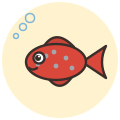
Not furry, but we like them anyway.
Red Devil Cichlid
Amphilophus labiatus (Günther, 1864)
Also called Red devil, Dicklippigerbuntbarsch, Heros labiatus (former name), Cichlasoma labiatum (former name)
From Central America: Lake Nicaragua and Lake Managua in Nicaragua, which are linked by the Tipitapa River. It lives around rocky shorelines and crevices.123
At a glance the quick version
Looks how to spot one
Large, deep-bodied cichlid
A big, powerful cichlid with a tall body and thick lips. Adult males grow larger than females, carry longer pointed dorsal and anal fins and often develop a prominent hump on the forehead. Some wild fish have extra-large lips, a feature that usually shrinks in aquarium life.13
Personality what they are like
A confident, strong-willed fish with plenty of personality. It is very territorial, especially when breeding, so it is usually kept alone or as a pair rather than in a community tank.13
Daily activity how busy a day looks
Active and inquisitive; likes to rearrange its surroundings by digging and moving decor, so furnishings should be heavy and secure.1
Grooming and care the hands-on bits
Needs a very large tank with strong filtration and regular water changes. Heaters and equipment should be protected, and rockwork placed directly on the tank base so it cannot be undermined.13
Home where they are happiest
Minimum base of about 150 x 45 cm for one adult; pairs or mixed setups need well over 1000 litres. Aquarium temperature 21-26 °C, pH 6.0-8.0, hardness 5-25 dGH. FishBase lists a warmer natural range of 28-33 °C for wild habitat.12
Food basics what goes in the bowl
An easy-going omnivore. A quality cichlid pellet as the staple, plus earthworms, prawns, mussels and vegetables such as peas or spinach. In the wild it eats small fish, snails, insect larvae, worms and bottom-dwelling creatures.12
Company who they like around
Best kept singly or as a bonded pair. Pairs form naturally from a group of young fish; tankmates, if any, should be large and robust and only in very big aquaria.1
The story where it all began
Albert Günther described the red devil in 1864 from the great lakes of Nicaragua. It became a popular aquarium fish, and selective breeding in captivity produced the bright orange and red forms that gave it its trade name, a name it often shares with the related Midas cichlid. It is also one of the parent fish used to create the flowerhorn hybrid.314
Fun facts for the dinner table
- 1
Wild red devils are mostly grey or greenish; the vivid orange and red fish seen in shops come largely from aquarium breeding.1
- 2
Keepers report that red devils soon learn to recognise the person who feeds them.1
- 3
Some wild fish grow strikingly thick lips, thought to be linked to their natural diet, which tend to shrink in captivity.3
- 4
The red devil is one of the cichlids used to create the flowerhorn hybrid.4
- 5
A female can lay roughly 600-700 eggs in one spawning, and both parents guard the brood.2
Recognised by the official bits
- IUCN Red List
- Not Evaluated2
- Taxonomy
- Described by Günther in 1864; formerly placed in Heros and Cichlasoma; family Cichlidae3
The care rhythm Furry Diary remembers it for you
A typical home-care rhythm for a Red Devil Cichlid. It is our own starting plan, not a vet's advice, and you can change every line in the app.
- Feedingevery day
- Water changeAbout 30 to 50% of the waterevery week
- Water testevery week
- Filter rinseevery 2 weeks
You might also like
 Midas Cichlid
 Flowerhorn Cichlid
 Blood Parrot Cichlid
Like what we are building? Buy us a coffee.
The breed atlas is free for everyone, with a source on every fact, and it will never show ads. If it helped you, a small tip keeps the research going. Any amount is lovely, and no is a perfectly fine answer too.
Where this comes from
Every breed page shows where each fact comes from. If we got something wrong, sorry, we are pet people, not a science magazine. Tell us at support@furrydiary.app and we will fix it.
- Seriously Fish: Amphilophus labiatus seriouslyfish.comused for range, size, care, water, diet, behaviour, colour, breeding
- FishBase: Amphilophus labiatus fishbase.seused for distribution, max length and weight, wild temperature, diet, IUCN
- Wikipedia: Amphilophus labiatus en.wikipedia.orgused for describer, colour variation, lips, behaviour
- Wikipedia: Flowerhorn cichlid en.wikipedia.orgused for role as flowerhorn parent
Checked 2026-09-30. Text is written in our own words from these sources.