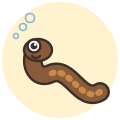
Not furry, but we like them anyway.
Peacock Eel
Macrognathus siamensis
Also called Spotfin spiny eel, Peacock spiny eel
From Southeast Asia: the Mekong, Chao Phraya and Maeklong river systems in Thailand, Cambodia, Laos and Vietnam, living in slow backwaters with sandy or muddy bottoms.12
At a glance the quick version
About 20 cm is typical; the recorded maximum is 30 cm standard length.
Hobby source only; no scientific lifespan data found.
Looks how to spot one
Slim, eel-like body with tiny scales and a row of small spines along the back
A long, brown fish with a pointed, trunk-like snout and a pale yellowish line running down each side. Its signature feature is a row of 3-6 dark, ringed eyespots along the base of the rear back fin.13
Personality what they are like
Gentle and shy. It gets along with calm fish too big to eat, such as rainbowfish, larger gouramis and swordtails, but may snack on very small fish or shrimp.32
Daily activity how busy a day looks
Comes out at dusk and night to search the bottom for food, and spends much of the day buried in sand with just its head showing.1
Grooming and care the hands-on bits
Give it several centimetres of fine, soft sand so it can burrow, plus caves and plants. A well-fitted lid is sensible for a slim, wriggly fish.32
Home where they are happiest
A long tropical freshwater tank; Fishkeeping World suggests at least 35 US gallons (about 130 L), 22-28 °C, pH 6.0-7.0 and 6-25 dGH. Soft sand is essential, along with dim areas, roots and plants.3
Food basics what goes in the bowl
Carnivore. In the wild it hunts insect larvae, small crustaceans and worms on the bottom. In the aquarium it prefers live and frozen foods such as bloodworm, brine shrimp and daphnia, best offered in the evening.13
Company who they like around
Can live alone or with others of its kind in a roomy tank that has plenty of hiding spots, so each eel has its own space.3
The story where it all began
Albert Günther described this fish in 1861 as a subspecies of another spiny eel, and it was later moved to the genus Macrognathus. It has long been traded both as a food fish in its homeland and as an aquarium fish.21
Fun facts for the dinner table
- 1
Its common name comes from the eyespots near its tail, which look like the 'eyes' on a peacock's feathers.1
- 2
It often hides buried in sand or silt with only the tip of its head sticking out.1
- 3
It breeds during the wet season when the nearby forests flood, and the young can reach about 8 cm in roughly two months.2
- 4
Despite the name it is not a true eel but a spiny eel, a separate group of fish.1
Recognised by the official bits
- FishBase
- Described by Günther in 1861 (originally as Rhynchobdella aculeata siamensis); family Mastacembelidae, the spiny eels, which are not true eels.1
- IUCN Red List (via FishBase)
- Least Concern (assessed 2011).1
The care rhythm Furry Diary remembers it for you
A typical home-care rhythm for a Peacock Eel. It is our own starting plan, not a vet's advice, and you can change every line in the app.
- Feedingevery day
- Water changeAbout 30 to 50% of the waterevery week
- Water testevery week
- Filter rinseevery 2 weeks
You might also like
 Tire Track Eel
 Fire Eel
Like what we are building? Buy us a coffee.
The breed atlas is free for everyone, with a source on every fact, and it will never show ads. If it helped you, a small tip keeps the research going. Any amount is lovely, and no is a perfectly fine answer too.
Where this comes from
Every breed page shows where each fact comes from. If we got something wrong, sorry, we are pet people, not a science magazine. Tell us at support@furrydiary.app and we will fix it.
- Macrognathus siamensis, Peacock eel - FishBase fishbase.seused for origin, taxonomy, IUCN status, size, appearance, behaviour, diet
- Macrognathus siamensis - Wikipedia en.wikipedia.orgused for other names, distribution, size, breeding, history
- Peacock Eel Care Guide - Fishkeeping World fishkeepingworld.comused for tank size, water parameters, substrate, diet, temperament, lifespan
Checked 2026-09-30. Text is written in our own words from these sources.