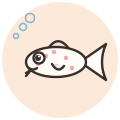
Not furry, but we like them anyway.
Panda Corydoras
Hoplisoma panda (Nijssen & Isbrücker, 1971); long known as Corydoras panda
Also called Panda cory, Panda catfish, Corydoras panda (former name)
From Upper Amazon basin in Peru and Ecuador, including the Ucayali system and tributaries of the Rio Pachitea in the Huánuco region. Most aquarium fish today are farm-bred in Eastern Europe and Asia.123
At a glance the quick version
Standard length; FishBase 3.8 cm, Seriously Fish 5.0 cm, Wikipedia 5.5 cm.
Looks how to spot one
Armoured catfish (bony plates, no scales)
A small, rounded catfish clad in bony plates, with short barbels for sifting sand. The body is off-white to soft pinkish-orange with a faint green sheen, set off by a black mask around each eye, a black patch on the dorsal fin and a black spot at the base of the tail, a pattern that recalls a giant panda. Females are a little larger and rounder.13
Personality what they are like
Exceptionally gentle and sociable. Pandas are shy alone but become confident, active and fun to watch in a group, rooting through the sand side by side.31
Daily activity how busy a day looks
Busy bottom foragers that also dart to the surface now and then to gulp air, so the surface must stay reachable. Open sandy areas let them sift for food naturally.342
Grooming and care the hands-on bits
Water: about 22 to 25 C (sources span 20 to 25 C as the preferred range), pH 6.0 to 7.4 per Seriously Fish (FishBase 6.0 to 8.0), hardness 1 to 12 dGH. Prefers slightly cooler, soft water. Keep the sand clean with regular partial water changes because they spend their lives on the bottom.321
Home where they are happiest
A tank of at least 45 x 30 x 30 cm (about 41 litres) for a small group, with fine smooth sand, some cover such as plants, wood or leaf litter, and gentle to moderate flow.3
Food basics what goes in the bowl
Omnivorous and easy to feed: a good sinking pellet or tablet as the staple, plus small live or frozen foods such as daphnia, brine shrimp or bloodworm.3
Company who they like around
A schooling fish that should never be kept alone; Seriously Fish advises groups, and Wikipedia suggests eight or more. Good with small, peaceful community fish.31
The story where it all began
Randolph H. Richards first collected the species in 1968, and Han Nijssen and Isaäc Isbrücker described it in 1971, naming it for its panda-like eye patches. It was very expensive when it reached the hobby in the late 1970s, but large-scale farming has since made it one of the most familiar corydoras.13
Fun facts for the dinner table
- 1
Its name comes from the black eye patches that resemble those of a giant panda.1
- 2
Like its relatives it can breathe air: it darts up, gulps at the surface and absorbs oxygen through its gut.4
- 3
When first imported in the late 1970s it was wildly expensive; captive breeding has since made it affordable.3
- 4
Eggs hatch in about three to four days at 22 C, and young fish gain their adult pattern after 10 to 12 weeks.1
- 5
The new genus name Hoplisoma means 'armoured body', referring to the bony plates on its sides.5
Recognised by the official bits
- IUCN Red List
- Near Threatened (assessed 24 April 2014)2
- Taxonomy
- Moved from Corydoras to the resurrected genus Hoplisoma after a 2025 phylogenomic study by Dias, Tencatt, Roxo and colleagues (Zoological Journal of the Linnean Society)5
- Family
- Callichthyidae (armoured catfishes)4
The care rhythm Furry Diary remembers it for you
A typical home-care rhythm for a Panda Corydoras. It is our own starting plan, not a vet's advice, and you can change every line in the app.
- FeedingSmall amounts once or twice a dayevery day
- Temperature checkevery day
- Water changeAbout 25% of the waterevery week
- Water testevery week
- Glass cleanevery week
- Filter rinseRinse in old tank water, never tap waterevery month
You might also like
 Bronze Corydoras
 Sterbai Corydoras
 Julii Corydoras
Like what we are building? Buy us a coffee.
The breed atlas is free for everyone, with a source on every fact, and it will never show ads. If it helped you, a small tip keeps the research going. Any amount is lovely, and no is a perfectly fine answer too.
Where this comes from
Every breed page shows where each fact comes from. If we got something wrong, sorry, we are pet people, not a science magazine. Tell us at support@furrydiary.app and we will fix it.
- Wikipedia: Panda corydoras en.wikipedia.orgused for names, history, description, breeding, social needs
- FishBase: Hoplisoma panda fishbase.seused for valid name, size, range, environment, IUCN status
- Seriously Fish: Corydoras panda seriouslyfish.comused for size, care, behaviour, diet, history
- Wikipedia: Corydoras en.wikipedia.orgused for air breathing, family
- Wikipedia: Hoplisoma en.wikipedia.orgused for genus change, name meaning
Checked 2026-09-30. Text is written in our own words from these sources.