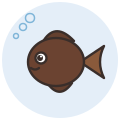
Not furry, but we like them anyway.
Mimic Tang
Acanthurus pyroferus
Also called Chocolate surgeonfish, Mimic surgeonfish, Chocolate tang, Yellow mimic tang, Orange-gilled surgeonfish
From Tropical Indo-Pacific, from the Seychelles east to the Marquesas and Tuamotus, north to southern Japan and south to the Great Barrier Reef, New Caledonia and New South Wales; on reefs at about 2 to 60 m depth12
At a glance the quick version
Looks how to spot one
Laterally compressed surgeonfish (tang)
An oval, flat-sided tang with a crescent-shaped tail. Adults are a warm chocolate to yellowish brown with a pale ring around the mouth, a dark bar from the chin to the gill cover, an orange patch near the pectoral fin base and a white edge on the tail. Youngsters look completely different, wearing the bright yellow or yellow-and-black colours of small dwarf angelfish.213
Personality what they are like
An active, generally peaceful grazer that tends to live alone on the reef. Youngsters can share space, but grown fish become more territorial, so it is best kept as a single tang in a roomy tank.123
Daily activity how busy a day looks
An active open-water swimmer that needs plenty of free swimming room plus rockwork with crevices to retreat into and sleep in.3
Grooming and care the hands-on bits
Rated easy care by a specialist retailer. Keep good water flow, run a protein skimmer and make regular water changes. Let some algae grow for grazing and acclimate it slowly.3
Home where they are happiest
A large marine aquarium of around 450 to 500 litres (a retailer suggests 120 US gallons) with lots of live rock, open swimming space and strong water movement. Suggested water: 23 to 28 C, pH 8.1 to 8.4, specific gravity 1.020 to 1.025. Reef safe with corals and invertebrates.3
Food basics what goes in the bowl
A herbivore that grazes algae and detritus in the wild. In the aquarium offer marine algae such as nori or spirulina sheets every day, plus quality herbivore flakes, pellets and frozen foods.123
Company who they like around
Usually seen singly in the wild. Keep one per tank, and add other tangs only with care in very large systems, since adults defend their space.123
The story where it all began
The species was described in 1834 by the Prussian naturalist Heinrich von Kittlitz from specimens taken in the Caroline Islands. It has long been noted by divers and scientists for the way its young copy different dwarf angelfish depending on where they live, and it is regularly kept in reef aquariums.21
Fun facts for the dinner table
- 1
Young mimic tangs dress up as whichever dwarf angelfish lives nearby: around Guam they copy the yellow lemonpeel angelfish, while in Palau, where that angel is missing, they copy the pearlscale angelfish instead.1
- 2
Where both model angelfish live, as in Vanuatu, juveniles may copy either one or even look like a blend of the two.2
- 3
FishBase records a maximum age of 28 years for this species.1
- 4
Adults can reach about 29 cm long, so the little yellow youngster grows into a sizeable tang.1
Recognised by the official bits
- IUCN Red List
- Least Concern (assessed May 2010)1
- Taxonomy
- First described by Heinrich von Kittlitz in 1834, type locality the Caroline Islands2
The care rhythm Furry Diary remembers it for you
A typical home-care rhythm for a Mimic Tang. It is our own starting plan, not a vet's advice, and you can change every line in the app.
- FeedingSmall amounts once or twice a dayevery day
- Temperature checkevery day
- Salinity checkevery week
- Top-upTop up evaporation with fresh RO water, not salt waterevery day
- Water testevery week
- Water changeAbout 10 to 20% of the waterevery 2 weeks
- Glass cleanevery week
You might also like
 Powder Blue Tang
 Achilles Tang
 Lemonpeel Angelfish
Like what we are building? Buy us a coffee.
The breed atlas is free for everyone, with a source on every fact, and it will never show ads. If it helped you, a small tip keeps the research going. Any amount is lovely, and no is a perfectly fine answer too.
Where this comes from
Every breed page shows where each fact comes from. If we got something wrong, sorry, we are pet people, not a science magazine. Tell us at support@furrydiary.app and we will fix it.
- FishBase: Acanthurus pyroferus fishbase.seused for range, size, depth, diet, mimicry, max age, IUCN
- Wikipedia: Acanthurus pyroferus en.wikipedia.orgused for names, description, history, colours, mimicry
- Saltwaterfish.com: Yellow Mimic (Chocolate) Tang saltwaterfish.comused for aquarium care, tank size, water parameters, diet, lifespan
Checked 2026-09-30. Text is written in our own words from these sources.