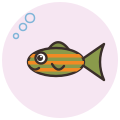
At a glance the quick version
Looks how to spot one
Tiny scaled livebearer
A very small, slender fish. Males stay around 2 cm and carry a long gonopodium, while females grow to about 3 cm with a rounder belly.23
Personality what they are like
A gentle, shy little fish that suits a quiet species tank or a nano setup with other very small, peaceful animals.3
Daily activity how busy a day looks
Low; spends its time among dense plants rather than swimming long distances.13
Grooming and care the hands-on bits
Easy to care for. Small, frequent feeds of tiny foods and a well-planted tank are the main needs.3
Home where they are happiest
A small aquarium from about 30 x 20 x 20 cm suits a pair. Water 20-26 °C, pH 7.0-8.0, moderately hard (about 5-20 dGH). Dense planting mirrors its weedy, still-water home.31
Food basics what goes in the bowl
Omnivore. Tiny live or frozen foods such as brine shrimp and daphnia, plus crushed flakes with some plant content.31
Company who they like around
Kept in small groups; tankmates should be equally tiny and calm, such as pygmy corydoras, otocinclus or dwarf shrimp.3
The story where it all began
Despite its common name, this fish is a livebearer in the guppy family rather than a true killifish. It has long been kept by hobbyists for its tiny size and was listed among the world's smallest fish in the 1991 Baensch Aquarium Atlas.23
Fun facts for the dinner table
- 1
It is the smallest fish species found in North America.2
- 2
Mothers nourish their developing young directly, so the embryo gets nearly all its food from the mother.1
- 3
Instead of one big brood, a female releases a few fry at a time over 10-14 days, as embryos at different stages develop together (superfetation).2
- 4
Newborn fry are large enough to eat brine shrimp nauplii straight away.3
Recognised by the official bits
- IUCN Red List
- Least Concern (assessed 2012)1
- Taxonomy
- Family Poeciliidae (a livebearer, despite the common name)2
The care rhythm Furry Diary remembers it for you
A typical home-care rhythm for a Least Killifish. It is our own starting plan, not a vet's advice, and you can change every line in the app.
- FeedingSmall amounts once or twice a dayevery day
- Temperature checkevery day
- Water changeAbout 25% of the waterevery week
- Water testevery week
- Glass cleanevery week
- Filter rinseRinse in old tank water, never tap waterevery month
You might also like
 Endler's Livebearer
 Guppy
Guppy Western Mosquitofish
Like what we are building? Buy us a coffee.
The breed atlas is free for everyone, with a source on every fact, and it will never show ads. If it helped you, a small tip keeps the research going. Any amount is lovely, and no is a perfectly fine answer too.
Where this comes from
Every breed page shows where each fact comes from. If we got something wrong, sorry, we are pet people, not a science magazine. Tell us at support@furrydiary.app and we will fix it.
- FishBase: Heterandria formosa fishbase.seused for origin, size, environment, diet, IUCN, reproduction
- Wikipedia: Least killifish en.wikipedia.orgused for names, colour, history, facts
- Seriously Fish: Heterandria formosa seriouslyfish.comused for tank size, water, diet, behaviour
Checked 2026-09-30. Text is written in our own words from these sources.