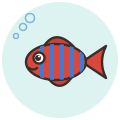
Not furry, but we like them anyway.
Dwarf Gourami
Trichogaster lalius (Hamilton, 1822)
Also called Kholisha (Bangladesh), Khosti (India), Kungee (Punjab), Colisa lalia (former name), Powder blue gourami (colour form)
From South Asia: Pakistan, India and Bangladesh, in slow, weedy streams, ponds, swamps, ditches, lakes and irrigation canals. Aquarium fish today are captive-bred, and feral populations exist outside the native range (e.g. Singapore, USA, Colombia).123
At a glance the quick version
Looks how to spot one
Scaled, laterally compressed labyrinth fish
A small, deep, flattened fish with a long-based dorsal and anal fin and a pair of thin, thread-like pelvic fins that work like feelers. Wild-type males are patterned with slanting bands of red and bright blue, while females are a plainer silver. Males grow a little larger and their dorsal and anal fins extend further, which makes pairs easy to tell apart.324
Personality what they are like
A gentle, somewhat shy fish that likes cover and slow water. It mixes well with small, peaceful tankmates, but males can stake out a territory and will squabble with other males, so one male per tank, ideally kept with a female, is the usual plan. Lively or very colourful fin-flashing species and other gouramis can provoke the male.23
Daily activity how busy a day looks
Not a fast swimmer: it cruises slowly through plants and regularly rises to the surface to take a breath of air. Gentle filtration and minimal current suit it best.251
Grooming and care the hands-on bits
Keep the water clean and stable with regular partial water changes and gentle filtration. Water: about 22-28 C, pH roughly 6.0-8.0 (6.0-7.5 is a comfortable middle), hardness about 2-19 dGH.21
Home where they are happiest
A tank of at least 60 cm length (around 56 litres) for a pair, densely planted, with low water movement and plant material the male can use for nest building. Because it breathes air at the surface, leave open space at the top.21
Food basics what goes in the bowl
An omnivore that in the wild grazes small invertebrates, algae and the film of tiny life on plants and stones. In the aquarium a good flake or pellet works as the staple, topped up with frozen or live foods such as bloodworm and brine shrimp, plus some plant-based food.23
Company who they like around
Best kept singly or as a male-female pair, not as a group of males. Good companions are small peaceful fish such as rasboras, small tetras, loaches and Corydoras catfish.2
The story where it all began
The Scottish surgeon-naturalist Francis Hamilton described the species in 1822 from his surveys of fishes in the Ganges region. In its homeland in Pakistan, India and Bangladesh it was long caught as a small food fish and has its own local names. Over the following two centuries scientists shuffled it between several genera, and for a long time aquarists knew it as Colisa lalia before it was moved into Trichogaster. It became one of the classic community aquarium fishes, and breeders went on to produce solid-colour forms such as powder blue, flame red and neon blue. Virtually all fish in the trade are now captive-bred.321
Fun facts for the dinner table
- 1
It has a labyrinth organ, a folded chamber above the gills that lets it gulp air at the surface and absorb oxygen from it, handy in warm, oxygen-poor water.5
- 2
The genus name Trichogaster comes from Greek for 'hair' and 'belly', after the long, hair-like pelvic fin rays.4
- 3
Those thread-like pelvic fins carry touch-sensitive cells, so the fish uses them to feel its way around.3
- 4
It can shoot a small jet of water from its mouth to knock prey off surfaces just above the water, reaching about 5 cm.3
- 5
The male builds a floating nest of bubbles woven with bits of plant, then guards the eggs and young until they swim freely.3
- 6
A single spawning can produce several hundred eggs, with broods of up to about 700-800 recorded.2
- 7
The eggs hatch fast, within about 12-36 hours, and the fry are free-swimming around three days later.3
Recognised by the official bits
- IUCN Red List
- Least Concern (assessed 21 January 2010)1
- Taxonomy
- Described by Francis Hamilton in 1822; placed over time in Trichopodus, Polyacanthus and Colisa before settling in Trichogaster. Family Osphronemidae (gouramis).3
- Taxonomy
- One of four species in the genus Trichogaster, alongside the honey, banded and thick-lipped gouramis4
The care rhythm Furry Diary remembers it for you
A typical home-care rhythm for a Dwarf Gourami. It is our own starting plan, not a vet's advice, and you can change every line in the app.
- FeedingSmall amounts once or twice a dayevery day
- Temperature checkevery day
- Water changeAbout 25% of the waterevery week
- Water testevery week
- Glass cleanevery week
- Filter rinseRinse in old tank water, never tap waterevery month
You might also like
 Honey Gourami
 Banded Gourami
 Betta
BettaLike what we are building? Buy Archy a bone.
All of this is free for everyone, with a source on every fact, and it will never show ads. It was a big job to build, so if it helped you, buy Archy a bone. Any amount is lovely, and no is a perfectly fine answer too.
Archy is our Australian Cattle Dog and chief taste tester. Tips go to 4V3D OÜ, the small family studio behind Furry Diary.
Where this comes from
Every breed page shows where each fact comes from. If we got something wrong, sorry, we are pet people, not a science magazine. Tell us at support@furrydiary.app and we will fix it.
- FishBase: Trichogaster lalius, Dwarf gourami fishbase.seused for max length, distribution, habitat, water parameters, IUCN status, air-breathing, minimum tank size
- Seriously Fish: Trichogaster lalius (Dwarf Gourami) seriouslyfish.comused for standard length, habitat, tank size, water parameters, diet, compatibility, dimorphism, breeding
- Wikipedia: Dwarf gourami en.wikipedia.orgused for taxonomy, synonyms, local names, lifespan, colour forms, fun facts, history
- Wikipedia: Trichogaster en.wikipedia.orgused for genus members, etymology of genus name
- Wikipedia: Osphronemidae en.wikipedia.orgused for labyrinth organ, air breathing
Checked 2026-09-30. Text is written in our own words from these sources.