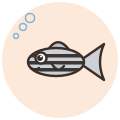
Not furry, but we like them anyway.
Denison Barb
Sahyadria denisonii
Also called Roseline shark, Red-line torpedo barb, Denison's barb, Miss Kerala, Denison's flying fox
From Asia: endemic to the Western Ghats of southern India, in fragmented river populations in Kerala and Karnataka123
At a glance the quick version
Wikipedia gives a typical adult size of 9 to 11 cm; Seriously Fish gives 11 cm maximum standard length; FishBase gives 15 cm maximum total length
Aquarium Source says up to about five years in captivity
Looks how to spot one
Scaled cyprinid (barb), torpedo-shaped
A sleek, streamlined silver fish built for speed. A bold black band runs along the flank from nose to tail, topped by a vivid scarlet line that starts at the snout and passes through the eye to about mid-body. The dorsal fin carries a red flash, and the tail has diagonal black and yellow bands. Older fish often pick up a green sheen on the head.1234
Personality what they are like
A lively and mostly peaceful shoaling fish. It does best with tankmates of a similar size and speed, and it is calmest when kept in a proper group with plenty of room.14
Daily activity how busy a day looks
Very active swimmer that needs a long tank with open swimming space, good water movement and plenty of oxygen.14
Grooming and care the hands-on bits
Needs very clean, well-oxygenated water, so regular partial water changes and strong filtration are part of the routine. Seriously Fish suggests a tank base of at least 120 x 45 cm (about 240 litres); Aquarium Source suggests at least 55 US gallons for a small group. Water: about 15 to 25 C, pH 6.5 to 7.8, hardness 5 to 25 dGH.142
Home where they are happiest
In the wild it lives in fast-flowing hill streams and rocky pools edged with dense vegetation. A long aquarium with current, smooth rocks, some plants and an open swimming lane suits it well.21
Food basics what goes in the bowl
Omnivorous. Offer a quality flake or granule (sinking foods are taken readily) plus small live or frozen foods such as bloodworm, Daphnia and brine shrimp, and some vegetable matter. Foods rich in carotenoids help keep the red colour bright.14
Company who they like around
A shoaling species that should be kept in a group of at least six, ideally six to ten or more.14
The story where it all began
Francis Day described this barb in 1865 and named it after Sir William Denison. It reached the international aquarium hobby from India in the late 1990s, won a prize at Aquarama in 1997 and quickly became one of India's most exported ornamental fish. Captive breeding was first achieved in Kerala in 2009, and most fish in the trade are now commercially bred.31
Fun facts for the dinner table
- 1
Around 2007 to 2008 it made up roughly 60 to 65 percent of all live ornamental fish exported from India.3
- 2
Its many nicknames include 'Miss Kerala', after the Indian state where it is found.3
- 3
It was a prize winner in the New Species category at the Aquarama show in 1997, shortly after first appearing in the trade.3
- 4
Unlike most tropical barbs, it is comfortable in fairly cool water, down to around 15 C.2
Recognised by the official bits
- IUCN Red List
- Assessed as Endangered (EN), July 20102
- Scientific description
- Described by Francis Day in 18652
- Aquarama 1997
- Took third prize in the New Species category3
The care rhythm Furry Diary remembers it for you
A typical home-care rhythm for a Denison Barb. It is our own starting plan, not a vet's advice, and you can change every line in the app.
- FeedingSmall amounts once or twice a dayevery day
- Temperature checkevery day
- Water changeAbout 25% of the waterevery week
- Water testevery week
- Glass cleanevery week
- Filter rinseRinse in old tank water, never tap waterevery month
You might also like
 Arulius Barb
 Melon Barb
 Tinfoil Barb
Like what we are building? Buy us a coffee.
The breed atlas is free for everyone, with a source on every fact, and it will never show ads. If it helped you, a small tip keeps the research going. Any amount is lovely, and no is a perfectly fine answer too.
Where this comes from
Every breed page shows where each fact comes from. If we got something wrong, sorry, we are pet people, not a science magazine. Tell us at support@furrydiary.app and we will fix it.
- Seriously Fish: Sahyadria denisonii seriouslyfish.comused for names, distribution, size, care parameters, diet, social needs, trade history
- FishBase: Dawkinsia denisonii summary fishbase.seused for IUCN status, describer, max length, water parameters, habitat
- Wikipedia: Sahyadria denisonii en.wikipedia.orgused for names, typical size, history, trade figures, fun facts
- Aquarium Source: Denison Barb care guide aquariumsource.comused for lifespan, tank size, diet, temperament, colour
Checked 2026-09-30. Text is written in our own words from these sources.