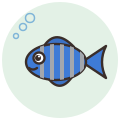
Not furry, but we like them anyway.
Convict Cichlid
Amatitlania nigrofasciata (Günther, 1867)
Also called Zebra cichlid, Pink convict, White convict
From Central America: Pacific and Atlantic slope rivers and lakes of Guatemala, El Salvador and Honduras; older accounts extend the range further south towards Costa Rica and Panama.123
At a glance the quick version
Looks how to spot one
Compact, deep-bodied Central American cichlid
A small, solid cichlid with eight or nine bold dark bars on a blue-grey body. Unusually for fish, females are the more colourful sex, with orange to pink tones on the belly and dorsal fin. Older males may grow a small forehead bump.32
Personality what they are like
Confident and full of character, and strongly territorial, especially once a pair starts breeding. Usually best in a tank of its own or with equally tough fish.23
Daily activity how busy a day looks
Active and curious; loves to dig and rearrange the substrate, which can uproot plants.2
Grooming and care the hands-on bits
Undemanding and robust; regular water changes and a varied diet keep it in top condition.2
Home where they are happiest
About 90 x 30 cm base for one pair, more for several fish; rocks, bogwood, roots and clay pots as caves. Water about 24 to 28 C, pH around 6.0 to 8.0 (slightly alkaline is preferred), hardness 5 to 25 dGH.21
Food basics what goes in the bowl
Unfussy omnivore: good flakes or pellets plus frozen or live foods and some vegetable matter.21
Company who they like around
Forms monogamous pairs that share parental duties; a single pair in its own aquarium is the classic setup.23
The story where it all began
Günther described the convict cichlid in 1867 from Central American specimens, and it has since been moved between several genera. Breeders developed white, pink and gold forms that lack the dark bars, and the species is widely used in studies of fish behaviour.3
Fun facts for the dinner table
- 1
The name convict comes from its stripes, which reminded people of old prison uniforms; nigrofasciata means black-striped.3
- 2
Parents can recognise each other by smell and tend their eggs in the dark.3
- 3
Pairs seem to sense when night is coming and gather their fry before dark.3
- 4
The pale pink and white forms come from a single recessive gene.3
- 5
Eggs hatch in about three days and the fry swim freely after a few more days.2
Recognised by the official bits
- IUCN Red List
- Data Deficient (assessed 5 June 2019)1
- Taxonomy
- Described by Albert Günther in 1867; moved to Amatitlania in 2007, earlier placed in Heros, Cichlasoma, Archocentrus and Cryptoheros3
The care rhythm Furry Diary remembers it for you
A typical home-care rhythm for a Convict Cichlid. It is our own starting plan, not a vet's advice, and you can change every line in the app.
- FeedingSmall amounts once or twice a dayevery day
- Temperature checkevery day
- Water changeAbout 25% of the waterevery week
- Water testevery week
- Glass cleanevery week
- Filter rinseRinse in old tank water, never tap waterevery month
You might also like
 Firemouth Cichlid
 Salvin's Cichlid
 Kribensis
Like what we are building? Buy Archy a bone.
All of this is free for everyone, with a source on every fact, and it will never show ads. It was a big job to build, so if it helped you, buy Archy a bone. Any amount is lovely, and no is a perfectly fine answer too.
Archy is our Australian Cattle Dog and chief taste tester. Tips go to 4V3D OÜ, the small family studio behind Furry Diary.
Where this comes from
Every breed page shows where each fact comes from. If we got something wrong, sorry, we are pet people, not a science magazine. Tell us at support@furrydiary.app and we will fix it.
- FishBase: Amatitlania nigrofasciata fishbase.seused for taxonomy, range, size, water, IUCN
- Seriously Fish: Amatitlania nigrofasciata seriouslyfish.comused for care, tank size, water, diet, behaviour, breeding
- Wikipedia: Convict cichlid en.wikipedia.orgused for names, history, colour forms, weight, fun facts
Checked 2026-09-30. Text is written in our own words from these sources.