Not furry, but we like them anyway.
Clown Triggerfish
Balistoides conspicillum (Bloch & Schneider, 1801)
Also called Bigspotted triggerfish
From Tropical and subtropical Indo-Pacific, from East Africa through northern Australia to Samoa and north to southern Japan, mainly on outer reef slopes.12
At a glance the quick version
Maximum 50 cm total length in the wild; aquarium fish usually stay smaller (around 20 in maximum).
Can live up to about 20 years.
Looks how to spot one
Scaled, oval triggerfish
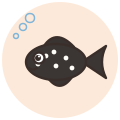
A thickset triggerfish with one of the boldest patterns on the reef. The black body carries large white polka dots on its lower half, a yellow leopard-like network on the back around the first dorsal fin, a yellow ring around the lips and a white band across the snout under the eyes. Young fish are black with small white spots and yellow touches on the snout.2
Personality what they are like
Confident, curious and strongly territorial, it grows bolder as it matures. It does best as a single showpiece fish with large, robust companions, and it is usually added to the tank last.23
Daily activity how busy a day looks
A daytime fish that roams the reef slope and retreats into caves and holes when it wants cover. It needs plenty of open swimming space and rockwork to explore.21
Grooming and care the hands-on bits
Rated easy to care for. It tends to rearrange decor, so arrange rockwork securely. Its teeth are sharp, so hand-feeding should be done with care.32
Home where they are happiest
A very large fish-only aquarium of about 1,135 litres (300 US gallons) or more, with caves. Water about 22 to 26 °C, pH 8.1 to 8.4, dKH 8 to 12, specific gravity 1.020 to 1.025.3
Food basics what goes in the bowl
A varied meaty diet of squid, krill, clams, small fish and hard-shelled shrimp, which also help wear down its ever-growing teeth. In nature it eats sea urchins, crabs and other crustaceans, molluscs and tunicates.312
Company who they like around
Solitary by nature; keep one per tank, choosing large, sturdy tankmates.123
The story where it all began
Marcus Bloch and Johann Gottlob Schneider described the species in 1801. Its vivid pattern has made it one of the most prized fish in the marine aquarium hobby.1
Fun facts for the dinner table
Recognised by the official bits
- IUCN Red List
- Least Concern (assessed 11 January 2022)1
- Taxonomy
- Family Balistidae; described by Bloch and Schneider in 18011
The care rhythm Furry Diary remembers it for you
A typical home-care rhythm for a Clown Triggerfish. It is our own starting plan, not a vet's advice, and you can change every line in the app.
- FeedingSmall amounts once or twice a dayevery day
- Temperature checkevery day
- Salinity checkevery week
- Top-upTop up evaporation with fresh RO water, not salt waterevery day
- Water testevery week
- Water changeAbout 10 to 20% of the waterevery 2 weeks
- Glass cleanevery week
You might also like
 Niger Triggerfish
 Picasso Triggerfish
Like what we are building? Buy us a coffee.
The breed atlas is free for everyone, with a source on every fact, and it will never show ads. If it helped you, a small tip keeps the research going. Any amount is lovely, and no is a perfectly fine answer too.
Where this comes from
Every breed page shows where each fact comes from. If we got something wrong, sorry, we are pet people, not a science magazine. Tell us at support@furrydiary.app and we will fix it.
- FishBase: Balistoides conspicillum summary fishbase.seused for distribution, depth, length, diet, IUCN status, behaviour, aquarium popularity
- Wikipedia: Clown triggerfish en.wikipedia.orgused for names, colour pattern, behaviour, lifespan, nesting, fun facts
- LiveAquaria: Clown Triggerfish liveaquaria.comused for aquarium care level, tank size, water parameters, diet, tankmates
Checked 2026-09-30. Text is written in our own words from these sources.