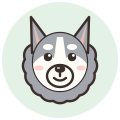
Will talk back, lovingly.
Siberian Husky
Also called Husky, Sibe, Chukchi sled dog (historical), Arctic Husky (former UKC name)
From Northeast Siberia, where the Chukchi people bred the ancestral sled dogs; developed as a pedigree breed in Alaska and the USA, which the FCI lists as country of origin1234
At a glance the quick version
FCI: males 20.5-28 kg, females 15.5-23 kg. AKC/UKC: males 45-60 lb (about 20.4-27.2 kg), females 35-50 lb (about 15.9-22.7 kg). Weight should be in proportion to height.
Coat and looks how to spot one
medium-length double coat
A medium-sized, lightly built sled dog with a compact, well-furred body, pricked triangular ears and a bushy tail. Its coat has two layers: a soft, thick undercoat that holds up straight, smooth-lying outer guard hairs, giving a plush but tidy look. The almond-shaped eyes can be brown, blue, one of each, or a mix of both colours in the same eye. When curled up to sleep, the dog often wraps its tail over its nose.564
Personality what they are like
The Siberian Husky is warm, easygoing and outgoing, affectionate without being clingy, and generally welcomes strangers rather than guarding against them. It is clever, independent-minded and good at solving problems, gets on well with other dogs and likes to be part of a group. Huskies are expressive and chatty, more likely to howl or 'talk' than bark, and they have a strong urge to run and a keen instinct to chase small animals.65384
Daily activity how busy a day looks
Very high. The Royal Kennel Club recommends more than two hours of exercise a day, and Hill's at least an hour of combined physical and mental work. Running, hiking, canicross, harness and sled sports suit it well. Because the drive to run is strong, the breed club advises exercising it on lead, in secure enclosures or in harness rather than off lead in open areas.283
Grooming and care the hands-on bits
Moderate. Brush about twice a week through the year, and daily during the seasonal moult when the undercoat 'blows' out. The coat needs no clipping; standards only allow tidying of whiskers and the fur between the toes. Bathe only when needed and trim nails every few weeks.837
Home where they are happiest
Best in a roomy home with a large, very securely fenced garden, since huskies can dig, climb or jump to explore; a fence of about 1.8 m (6 ft) is often advised. Its coat is built for cold weather, so in warm climates it needs shade and exercise at cooler times of day. Not an ideal match for a small flat or a quiet, stay-at-home lifestyle.284
Food basics what goes in the bowl
A good-quality complete diet with solid protein, adjusted to the dog's activity level. The breed club calls it an 'easy keeper' that needs relatively little food for its size, a legacy of pulling light loads efficiently; working sled dogs need more.38
Company who they like around
High. Huskies enjoy the company of people and other dogs and do best when they feel part of a pack; they are not one-person dogs and are usually friendly with visitors. Early introductions help if the home has cats or small pets, because of the breed's chase instinct.348
The story where it all began
The Siberian Husky's ancestors were bred for centuries by the Chukchi people of northeastern Siberia, who needed light, fast dogs that could pull modest loads over long distances in severe cold. The Chukchi selected carefully for working ability and temperament and raised the dogs close to their families. In 1909 these dogs were brought to Alaska in numbers for the All-Alaska Sweepstakes, a 408-mile race from Nome, where the small, quick teams soon proved themselves; Leonhard Seppala became their best-known driver. In the winter of 1925, relay teams of sled dogs carried diphtheria antitoxin to Nome, with Seppala and his lead dog Togo covering the longest stretch and Gunnar Kaasen's team, led by Balto, running the final leg. Seppala then toured and raced his dogs in New England, which helped lead to AKC recognition in 1930, the same year exports from Siberia stopped. Most American Siberians descend from those last imports and Seppala's dogs, especially Togo. The Siberian Husky Club of America was founded in 1938, Canada began registering the breed in 1939, and the dogs went on to serve on Admiral Byrd's Antarctic expedition and with the US Army's Arctic search and rescue unit in World War II.3247
Fun facts for the dinner table
- 1
A statue in New York's Central Park honours the sled dogs of the 1925 serum run to Nome.2
- 2
Blue eyes, brown eyes, one of each, or two colours within one eye are all accepted by the breed standards.5
- 3
People in Nome once nicknamed the imported dogs 'Siberian Rats' because they looked so small next to the bigger freighting dogs.4
- 4
Their double coat lets them cope with temperatures as low as about minus 50 to minus 60 degrees C.4
- 5
Huskies tend to howl and 'talk' rather than bark, and some imitate sounds such as sirens.4
- 6
Admiral Richard Byrd took about 50 Siberian Huskies on his 1933 Antarctic expedition.4
- 7
The breed club notes the Siberian Husky is naturally clean and has almost no body odour.3
- 8
The UKC first registered the breed in 1938 under the name 'Arctic Husky' and only switched to 'Siberian Husky' in 1991.7
Recognised by the official bits
- FCI
- Standard No. 270, Group 5 (Spitz and primitive types), Section 1 (Nordic Sledge Dogs); definitive acceptance 8 Sep 1966; current standard published 14 Nov 20221
- AKC
- Working Group; recognised 1930; current standard approved 9 Feb 2021, effective 12 May 20213
- The Royal Kennel Club
- Working Group2
- UKC
- Northern Breed Group; recognised 1938 as 'Arctic Husky', renamed Siberian Husky in March 19917
- Canadian Kennel Club
- First registered the breed in 19394
Popularity Ranked 30th of AKC-registered breeds in 2025 (down from 26th in 2024)9
The care rhythm Furry Diary remembers it for you
A typical home-care rhythm for a Siberian Husky. It is our own starting plan, not a vet's advice, and you can change every line in the app.
- BrushingDaily during heavy sheddingevery 3 days
- Deshedding spring and autumnExtra brushing while the coat blowsevery day
- Double coats insulate against cold and heat, so shaving is not recommended
- Bathevery 10 weeks
- Nail trimSooner if you hear clicking on the floorevery month
- Ear checkevery 2 weeks
- Teeth brushingDaily brushing is idealevery 2 days
- ExerciseAbout 120 minutes a dayevery day
- Heat care summerWalk in the cool morning and eveningevery day
- Flea, tick and worm protectionSchedule as your vet recommendsas your vet recommends
- Vet check-upSenior years usually start around age 8every year
You might also like
 Alaskan Malamute
 Samoyed
 Chinook
Like what we are building? Buy us a coffee.
The breed atlas is free for everyone, with a source on every fact, and it will never show ads. If it helped you, a small tip keeps the research going. Any amount is lovely, and no is a perfectly fine answer too.
Where this comes from
Every breed page shows where each fact comes from. If we got something wrong, sorry, we are pet people, not a science magazine. Tell us at support@furrydiary.app and we will fix it.
- FCI breed nomenclature: Siberian Husky (270) fci.beused for recognition, origin
- The Royal Kennel Club: Siberian Husky royalkennelclub.comused for group, exercise, home, lifespan, history
- Siberian Husky Club of America: The Siberian Husky shca.orgused for history, temperament, care, diet, exercise
- Wikipedia: Siberian Husky en.wikipedia.orgused for names, history, colours, fun facts (secondary)
- FCI Standard No. 270 Siberian Husky fci.beused for size, coat, colours, eyes, temperament
- AKC Official Standard of the Siberian Husky images.akc.orgused for size, coat, colours, temperament, standard dates
- UKC Siberian Husky breed standard ukcdogs.comused for recognition, size, coat, grooming, history
- Hill's Pet: Siberian Husky hillspet.comused for lifespan, exercise, grooming, diet, housing
- AKC Most Popular Dog Breeds of 2025 akc.orgused for popularity
Checked 2026-09-30. Text is written in our own words from these sources.