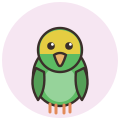
Peach-faced Lovebird
Agapornis roseicollis
Also called Rosy-faced lovebird, Rosy-collared lovebird, Rosy-headed lovebird, Rose-ringed lovebird
From Dry south-western Africa: south-western Angola, the western half of Namibia, south-western Botswana and the lower Orange River valley in the Northern Cape of South Africa. It lives in arid wooded country, savanna, sub-desert steppe and riverside woodland from sea level to about 1,500-1,600 m, always within reach of permanent water.123
At a glance the quick version
Looks how to spot one
Feathered; small, stocky parrot with a short tail
The wild-type bird is mostly bright green, with a rosy-pink face and throat that deepens to red on the forehead and above the eye, and a vivid blue rump. The short tail is green with blue tips and has black and red markings hidden near the base. The bill is horn-coloured, the eyes dark brown and the feet grey. Males and females look almost alike, though females can be a touch duller; youngsters show a paler pink face.321
Personality what they are like
A lively, confident little parrot with a big personality for its size. Peach-faced lovebirds are nosy and playful, love to chew and to hide in cosy spots, and keep up a steady stream of chatter. They are rarely strong talkers but make pleasant sounds, getting loudest around dawn and dusk. They can be assertive and will defend their space, so regular gentle handling helps keep a single pet tame. A bonded pair often focuses mainly on each other.645
Daily activity how busy a day looks
Very active. Plan for daily time out of the cage to fly and explore under supervision, plus a steady supply of toys to shred and climb on so the bird stays busy.36
Grooming and care the hands-on bits
Offer a shallow dish of water for bathing, as these birds like to bathe often. Chewable toys help keep the beak in shape; nails and wings can be trimmed by an avian vet when needed. Daily gentle handling keeps a single bird tame.345
Home where they are happiest
Get the largest cage you can fit. VCA suggests at least 90 cm long x 60 cm wide x 60 cm tall; the World Parrot Trust suggests an enclosure or aviary of at least 1.2 m. Bar spacing of about 0.95-1.1 cm suits this size of bird. Provide several natural perches of different thicknesses and sturdy chew-safe toys.4156
Food basics what goes in the bowl
In the wild they eat mostly seeds from grasses and trees such as acacia and albizia, along with buds, flowers and berries. As pets, a formulated diet (pellets) should form the base, topped up with small seeds, leafy greens, vegetables and fruit such as apple, pear and orange. Seed on its own is not a complete diet. Fresh water is important, as wild birds drink several times a day.1265
Company who they like around
Highly social flock birds that live in groups of about 5-20 in the wild. They are often kept in pairs, which bond tightly with each other. A single bird can be a very affectionate pet but needs lots of daily attention from its people plus toys to keep it occupied.236
The story where it all began
Vieillot gave the species its scientific name in 1818, first placing it in the broad parrot genus Psittacus before it was moved to Agapornis, the lovebird genus. In the wild it ranges over the dry south-west of Africa, where it often nests inside the huge communal nests built by sociable weavers, and has spread naturally in some areas such as around Lake Ngami thanks to man-made water points and structures. The bird has been kept in captivity since 1869, and because it is small, hardy and breeds readily it became the most widely kept lovebird. Breeders have developed the widest range of colour mutations of any lovebird, with lutino and Dutch blue among the favourites. Escaped pets have founded thriving free-living flocks in Phoenix and Tucson, Arizona, and on Maui and the Big Island of Hawaii.32174
Fun facts for the dinner table
- 1
Females carry nesting material in an unusual way: they snip strips of bark or leaves and tuck them into the feathers of their lower back to fly them home.2
- 2
It was the first parrot species reported to pass the mirror mark test, a classic check for self-recognition.3
- 3
In flight it can reach about 58 km/h, mixing fast wingbeats with short glides.2
- 4
Wild birds often move into the giant apartment-block nests of sociable weavers instead of building from scratch.2
- 5
When they sleep, a pair sits side by side with their faces turned in towards each other.3
- 6
In the Arizona heat, feral flocks in Phoenix have been seen crowding onto air-conditioner vents to cool off.3
- 7
Besides calls, they can make a soft rasping sound by rubbing the two halves of the beak together.2
Recognised by the official bits
- Taxonomy
- First described by the French ornithologist Louis Pierre Vieillot in 1818 as Psittacus roseicollis, later placed in the genus Agapornis (family Psittaculidae).3
- Subspecies
- Two subspecies are recognised: the nominate A. r. roseicollis and A. r. catumbella of Benguela, Angola, which shows deeper red on the forecrown and cheeks.1
- IUCN Red List
- Least Concern.1
- Aviculture
- Described by VCA Animal Hospitals as the largest and most commonly kept of the nine lovebird species; the World Parrot Trust lists it as common in captivity.4
The care rhythm Furry Diary remembers it for you
A typical home-care rhythm for a Peach-faced Lovebird. It is our own starting plan, not a vet's advice, and you can change every line in the app.
- Fresh food and waterevery day
- Cage linerevery 2 days
- Full cleanevery week
- Bath offerA shallow dish or gentle mistevery 3 days
- Nails checkevery month
- Toy rotationevery 2 weeks
- Out-of-cage timeAbout an hour a day, if tameevery day
- Vet check-upevery year
You might also like
 Fischer's Lovebird
 Masked Lovebird
 Lovebird
 Pacific Parrotlet
 Budgerigar
Like what we are building? Buy us a coffee.
The breed atlas is free for everyone, with a source on every fact, and it will never show ads. If it helped you, a small tip keeps the research going. Any amount is lovely, and no is a perfectly fine answer too.
Where this comes from
Every breed page shows where each fact comes from. If we got something wrong, sorry, we are pet people, not a science magazine. Tell us at support@furrydiary.app and we will fix it.
- Rosy-faced Lovebird - World Parrot Trust Parrot Encyclopedia parrots.orgused for names, subspecies, size, weight, range, habitat, diet, breeding, lifespan, housing, conservation
- Agapornis roseicollis - Animal Diversity Web (University of Michigan) animaldiversity.orgused for range, weight, colouring, nesting, flight speed, behaviour, lifespan, captive history, fun facts
- Rosy-faced lovebird - Wikipedia en.wikipedia.orgused for taxonomy, length, description, feral populations, mirror test, mutations, aviculture
- Lovebirds - General - VCA Animal Hospitals vcahospitals.comused for lifespan, cage size, personality, popularity among lovebird species
- Basic Information Sheet: Lovebird - LafeberVet lafeber.comused for weight, lifespan, bar spacing, diet type, handling
- Lovebird Personality, Food & Care - Lafeber lafeber.comused for temperament, vocal traits, housing, diet, social needs
- Lutino rosy-faced lovebird mutation - Wikipedia en.wikipedia.orgused for popular colour mutations
Checked 2026-09-30. Text is written in our own words from these sources.