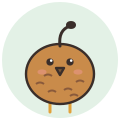
Bobwhite Quail
Colinus virginianus
Also called Northern Bobwhite, Virginia Quail, American Partridge (historic)
From North America and the Caribbean: Canada, the United States, Mexico and Cuba; introduced in parts of the Caribbean, Europe and Asia1
At a glance the quick version
Wingspan 33-38 cm.
Looks how to spot one
feathers
A plump, round, short-tailed quail patterned in mottled reddish-brown, buff and grey for camouflage. Males have a crisp white throat and eyebrow stripe edged in black; females show buff in those places instead.1
Personality what they are like
A lively, alert ground bird that likes company of its own kind. It is more of a backyard or aviary bird to watch and listen to than a lap pet.12
Daily activity how busy a day looks
Moves and forages on the ground; flight pens with vegetation give room to run and short flights.21
Grooming and care the hands-on bits
Provide clean water and feed daily, with enough feeder space (about 2.5 cm per adult bird) so all can eat. Very young chicks need shallow or covered waterers.2
Home where they are happiest
Adults need about 0.09 m2 (1 sq ft) per bird in floor pens or 0.05 m2 (0.5 sq ft) in cages; flight pens should give about 0.19 m2 (2 sq ft) per bird with plant cover, a mesh top and predator-proofed edges. Wire floors should use 6 mm (1/4 in) mesh.2
Food basics what goes in the bowl
Wild birds eat seeds, berries, grains and small invertebrates like crickets, beetles and grasshoppers. In captivity, feed a game bird starter of about 28% protein to 8 weeks, a 20% grower to 14 weeks, then a 13-14% maintenance ration, rising to 18-20% for breeding birds.12
Company who they like around
A covey species: pairs in spring, family groups in late summer, and winter groups of two dozen or more. Best kept in groups rather than alone.1
The story where it all began
The northern bobwhite is a native gamebird of eastern and central North America, long known for its whistled call. It is widely reared on game farms and in backyard pens for release, hunting and enjoyment.12
Fun facts for the dinner table
- 1
Its common name comes from its call, a clear whistle that rises about a full octave: 'bob-WHITE' or 'bob-bob-WHITE'.1
- 2
In winter, bobwhites may roost together in coveys of two dozen or more birds.1
- 3
A clutch averages around 15 eggs, which hatch after about 23 days.3
- 4
Around 20 subspecies are recognised across its range.1
Recognised by the official bits
- IUCN Red List
- Listed as Near Threatened.1
- Taxonomy
- About 20 subspecies are recognised.1
The care rhythm Furry Diary remembers it for you
A typical home-care rhythm for a Bobwhite Quail. It is our own starting plan, not a vet's advice, and you can change every line in the app.
- Fresh food and waterevery day
- Egg collectevery day
- Spot cleanevery day
- Full cleanevery week
- Dust bath checkQuail love a sand or dust bathevery 3 days
- Vet check-upFind a vet who sees exotic petsevery year
You might also like
 Button Quail
 Japanese Quail
Like what we are building? Buy Archy a bone.
All of this is free for everyone, with a source on every fact, and it will never show ads. It was a big job to build, so if it helped you, buy Archy a bone. Any amount is lovely, and no is a perfectly fine answer too.
Archy is our Australian Cattle Dog and chief taste tester. Tips go to 4V3D OÜ, the small family studio behind Furry Diary.
Where this comes from
Every breed page shows where each fact comes from. If we got something wrong, sorry, we are pet people, not a science magazine. Tell us at support@furrydiary.app and we will fix it.
- Northern bobwhite - Wikipedia en.wikipedia.orgused for names, range, size, plumage, diet, social behaviour, call, IUCN
- Bobwhite Quail Production - Penn State Extension extension.psu.eduused for space, feed and protein, pen design, care
- AnAge: Northern bobwhite (Colinus virginianus) genomics.senescence.infoused for longevity, body mass, clutch, incubation
Checked 2026-09-30. Text is written in our own words from these sources.