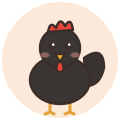
At a glance the quick version
Standard figures per Wikipedia; APA gives cock 8.5 lb (about 3.9 kg) and hen 6.5 lb (about 2.9 kg). Bantams: cock 0.96 to 1.23 kg, hen 0.79 to 1.04 kg.
Looks how to spot one
Soft, close-fitting glossy plumage
A deep-bodied, upright utility bird that is a little trimmer than its Orpington ancestor. It was selected for laying and table qualities rather than show fluff. It has a single comb, white skin and lays brown eggs.13
Personality what they are like
Active but gentle. Australorps are usually friendly, tolerate handling well and are a popular choice for families and young poultry exhibitors.24
Daily activity how busy a day looks
Moderate. They are busy foragers that enjoy daily run or garden time, while being calm enough for a backyard setting.25
Grooming and care the hands-on bits
Chickens keep their own plumage in order by preening and dust bathing, so the owner's job is a dry dust-bath spot, clean dry bedding, daily flock checks and regular egg collection. Backyard hens typically lay 250 or more brown eggs a year, and some go broody.524
Home where they are happiest
Needs a secure, dry, well-ventilated coop plus an outdoor run. The RSPCA suggests roughly 1 m² of indoor space per bird where possible; veterinary husbandry guidance gives 0.37 m² per large bird as a minimum, and Oregon State University Extension advises about 0.28 m² per bird when there is a run, or 0.75 to 0.9 m² without outdoor access. Allow at least 15 cm of perch per bird (more for big breeds), about one nest box per four hens, and a patch of dry soil for dust bathing. Australorps adapt to hot or cold weather but are happiest in cooler conditions.567
Food basics what goes in the bowl
A complete commercial ration forms the base: chick starter first, a lower-calcium grower feed until laying begins, then layer feed. An adult eats around 120 g of layers pellets a day, a little more in winter. Provide insoluble grit, oyster shell as extra calcium for layers, and fresh clean water at all times. In the UK, kitchen scraps may not be fed to poultry.56
Company who they like around
A flock bird that forages, roosts and dust bathes with companions, so keep at least three hens that get along.5
The story where it all began
Australian breeders imported Black Orpingtons around the turn of the 20th century and selected them for egg laying rather than show fluff, adding touches of other utility breeds along the way. The result was launched internationally in the early 1920s under the name Australorp, reached Britain around 1921 and joined the American standard in 1929.123
Fun facts for the dinner table
- 1
In a 1922 to 1923 laying trial, a team of six Australorp hens produced 1,857 eggs in 365 days, averaging about 309 eggs each and setting a world record at the time.1
- 2
The name is a shortened form of Australian black Orpington.3
- 3
Several people claimed credit for coining the name, including breeders in Australia and a British poultry writer.1
- 4
One Australorp hen is reported to have laid 364 eggs in 365 days.1
Recognised by the official bits
- American Poultry Association (Standard of Perfection)
- Admitted in 1929; black is the only colour in the US standard.1
- The Poultry Club of Great Britain
- Standardised breed, classed as soft feather heavy.3
- Australian standard
- Black, blue and white recognised in Australia; the white was added in 2012.1
- The Livestock Conservancy
- Graduated from the Conservation Priority List in 2023.2
The care rhythm Furry Diary remembers it for you
A typical home-care rhythm for a Australorp. It is our own starting plan, not a vet's advice, and you can change every line in the app.
- Fresh food and waterevery day
- Egg collectevery day
- Coop spot cleanevery day
- Coop full cleanFresh bedding and nest boxesevery month
- Mite checkLook under the wings and around the ventevery 2 weeks
- Dust bath checkKeep a dry dust bath spotevery week
- Free rangeDaily time outside in a safe runevery day
- Vet check-upFind a vet who sees poultryevery year
You might also like
 Orpington
 Rhode Island Red
 Wyandotte
Like what we are building? Buy us a coffee.
The breed atlas is free for everyone, with a source on every fact, and it will never show ads. If it helped you, a small tip keeps the research going. Any amount is lovely, and no is a perfectly fine answer too.
Where this comes from
Every breed page shows where each fact comes from. If we got something wrong, sorry, we are pet people, not a science magazine. Tell us at support@furrydiary.app and we will fix it.
- Australorp - Wikipedia en.wikipedia.orgused for origin, history, weights, colours, recognition, laying records
- Australorp Chicken - The Livestock Conservancy livestockconservancy.orgused for history, conservation status, APA year, temperament, laying
- Australorp - The Poultry Club of Great Britain poultryclub.orgused for classification, name, British history
- Australorp - Lafeber Backyard Chickens lafeber.comused for lifespan, laying, temperament, climate
- Keeping chickens as pets - RSPCA rspca.org.ukused for social needs, space, daily feed, grit, dust bathing
- Care of the Backyard Chicken - Lafeber Vet lafeber.comused for space, perches, diet stages, coop temperature
- Living on the land: Backyard chicken coop design - Oregon State University Extension extension.oregonstate.eduused for coop space, roosts, nest boxes
Checked 2026-09-30. Text is written in our own words from these sources.