Smarter than your smart speaker.
African Grey Parrot
Psittacus erithacus
Also called Grey parrot, Congo African grey parrot, Congo grey, CAG
From Equatorial West and Central Africa, from southern Nigeria and the eastern Ivory Coast east to Kenya, Uganda and north-western Tanzania, including the Gulf of Guinea islands of Bioko, Principe and Sao Tome. It lives in rainforest, forest edges, gallery forest, mangroves and wooded savanna from the lowlands up to about 2,200 m.12
At a glance the quick version
Looks how to spot one
Feathered; grey body with a bright red tail
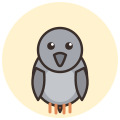
A stocky, medium-sized parrot about 33 cm long with a wingspan of roughly 46-52 cm. The plumage is soft grey, with each feather edged in paler grey or white so the bird looks gently scalloped. Head and wings are a shade darker than the body, the flight feathers darker still, and the short square tail and the feathers beneath it are a vivid red. The strong hooked beak is black, and a bare whitish patch of skin surrounds each eye. Young birds have dark eyes that turn pale yellow as they mature, which gives a rough clue to age.12
Personality what they are like
Thoughtful, observant and very bright. Greys are highly social but often prefer company and conversation to lots of cuddling, and many bond most closely with one person. They like predictable routines and a calm household, and tend to settle in best when changes are introduced gradually. They are usually quieter than many South American parrots, but they happily copy household sounds such as phones and microwaves and repeat them often.31
Daily activity how busy a day looks
High mental needs. Greys need daily time out of the cage with their people, plus a steady supply of puzzle and foraging toys that make them work for food and solve problems. Rotating toys and teaching new words or simple tasks keeps them engaged.13
Grooming and care the hands-on bits
Plan for a very long commitment, since greys can outlive many owners. Give plenty of hands-on interaction every day, keep a regular routine, and offer chewable and foraging toys to satisfy a strong beak. Birds on a balanced pellet-based diet generally need no extra vitamins, but a source of calcium should be available. Regular check-ups with an avian vet are advised.312
Home where they are happiest
A roomy, sturdy parrot cage with space to climb and stretch the wings, several perches and plenty of toys. Placing the cage against a wall rather than in the middle of a busy room helps the bird feel secure. Combine the cage with daily supervised time outside it.31
Food basics what goes in the bowl
In the wild greys eat mostly fruit, nuts and seeds, with oil palm fruit and figs as favourites, plus flowers, bark and the odd insect or snail. At home a good-quality pelleted food makes a sound base, topped up with fresh vegetables, especially orange and dark green ones such as cooked sweet potato and kale, and some fruit and nuts. Include a calcium source and fresh water daily.123
Company who they like around
Very high. Wild greys live in flocks that gather at large communal roosts and split into smaller groups to feed. A pet grey looks to its family as its flock and needs a lot of daily attention and conversation; a bird left alone for long stretches will not thrive.21
The story where it all began
People have kept grey parrots for thousands of years. Egyptian hieroglyphs from around 2000 BC appear to show them as pets, and the ancient Greeks and Romans kept them in cages and prized them as talking birds. Linnaeus gave the species its scientific name in 1758. Captive breeding has gone on since the 1800s, with breeders in South Africa, Australia, New Zealand and Scandinavia especially active, and this has produced a range of colour varieties. In modern times the grey became famous in science through Irene Pepperberg's work with a parrot named Alex, which began in 1977 and changed how researchers think about bird intelligence. Heavy trapping for the pet trade and forest loss reduced wild numbers, and in 2016 the species was listed as Endangered and given full protection under CITES, so pet greys today should come from captive-bred stock.152
Fun facts for the dinner table
- 1
Alex, the grey parrot studied by Irene Pepperberg, learned more than 100 words and could name seven colours and five shapes.4
- 2
Alex is said to be the first non-human animal known to ask a question: looking in a mirror, he asked what colour he was, and learned the word grey.4
- 3
Alex's name was short for Avian Learning Experiment, and he could count quantities up to six and showed a grasp of something like zero.4
- 4
Two wild greys that researchers recorded used over 200 different calls, including copies of nine other bird species and one bat.1
- 5
Studies suggest greys can solve some problems at a level compared with children aged four to six, and they will share food with other greys.1
- 6
You can roughly tell a young grey from an adult by its eyes: chicks have dark eyes that turn pale yellow as they grow up.1
- 7
Old communal roosts in Ghana once held 700 to 1,200 birds each.1
- 8
Many greys start talking properly at around one year old, and some copy a word after hearing it only once or twice.3
Recognised by the official bits
- IUCN Red List
- Listed as Endangered since 2016.1
- CITES
- Moved to Appendix I, the highest level of trade protection, in October 2016.1
- Taxonomy
- Described by Carl Linnaeus in 1758. The Timneh parrot, once treated as a subspecies, was recognised as a separate species (Psittacus timneh) in 2007, so the name grey parrot now covers the Congo form only.1
The care rhythm Furry Diary remembers it for you
A typical home-care rhythm for a African Grey Parrot. It is our own starting plan, not a vet's advice, and you can change every line in the app.
- Fresh food and waterevery day
- Cage linerevery day
- Full cleanevery week
- Bath offerevery 3 days
- Nails checkevery month
- Beak checkevery month
- EnrichmentPuzzles and foraging every dayevery day
- Out-of-cage timeAbout 3 hours a dayevery day
- Vet check-upevery year
You might also like
 Timneh Parrot
 Eclectus Parrot
 Senegal Parrot
Like what we are building? Buy us a coffee.
The breed atlas is free for everyone, with a source on every fact, and it will never show ads. If it helped you, a small tip keeps the research going. Any amount is lovely, and no is a perfectly fine answer too.
Where this comes from
Every breed page shows where each fact comes from. If we got something wrong, sorry, we are pet people, not a science magazine. Tell us at support@furrydiary.app and we will fix it.
- Grey parrot - Wikipedia en.wikipedia.orgused for range, size, lifespan, plumage, colour mutations, diet, behaviour, history, conservation, fun facts
- Grey Parrot - World Parrot Trust Parrot Encyclopedia parrots.orgused for range, habitat, size, plumage, diet, flocking, lifespan, conservation status
- African Grey - Lafeber Pet Birds lafeber.comused for temperament, talking, diet at home, enrichment, cage placement
- Alex (parrot) - Wikipedia en.wikipedia.orgused for fun facts about Alex
- Dr. Irene Pepperberg - The Alex Foundation alexfoundation.orgused for history of the research programme (started 1977)
Checked 2026-09-30. Text is written in our own words from these sources.